
Ghelna canadensis
(Banks, 1897)
Three-lined Ground Jumping Spider, Red Velvet Jumper
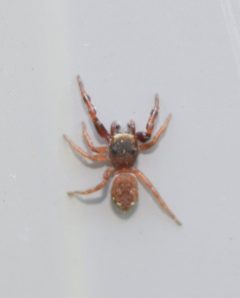
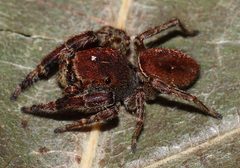
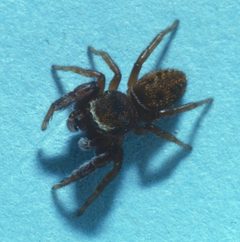
Ghelna canadensis is a small jumping spider in the Salticidae, measuring 4–6.4 mm in body length. Mature males are 4–5 mm, while females are slightly larger at 4.6–6.4 mm. The is notable for being ground-dwelling, which is unusual among its subtribe Dendryphantina, whose members are typically arboreal. Males have a distinctive red velvety appearance with three visible lines, while females are darker gray or brownish with indistinct markings. It occurs across much of the eastern United States and adjacent Canada.
Pronunciation
How to pronounce Ghelna canadensis: /ˈɡɛl.nə ˌkænəˈdɛn.sɪs/
These audio files are automatically generated. While they are not always 100% accurate, they are a good starting point.
Identification
Distinguished from the common Phidippus by the absence of iridescent . Males can be recognized by the red velvety coloration with three visible lines and fully formed terminal segments on . Females are darker with indistinct markings and may be more difficult to identify. The ground-dwelling contrasts with the typically arboreal habits of related Dendryphantina. Formerly placed in genus Metaphidippus. Similar in size to other small salticids but combination of color pattern, preference, and lack of iridescent jaws separates it from sympatric .
Images
Habitat
Ground-dwelling in open including lawns, prairie edges, and sidewalks. Found in areas with sparse vegetation and exposed ground surfaces. Unusual among subtribe Dendryphantina for its terrestrial rather than arboreal habits.
Distribution
Eastern United States and adjacent Canada. Western records extend to Minnesota in the north and near Dallas, Texas in the south. Excludes the southernmost tier of the eastern United States. Known from Kansas in Douglas and Jefferson counties; first Leavenworth County record documented in 2024.
Seasonality
have been documented in June through August. Female observed in June; male captured in late August.
Behavior
Exhibits notably slow, deliberate movements compared to the fast, bouncy locomotion typical of many jumping spiders. Mature males wander in search of mates. Captive individuals have been observed to accept water from moistened surfaces, suggesting they may experience desiccation stress in exposed .
Similar Taxa
- Phidippus spp.Common sympatric jumping spiders with iridescent and typically arboreal habits; G. canadensis lacks iridescent jaws and is ground-dwelling
- Ghelna barrowsiCongeneric occurring in same region; specific distinguishing features not documented in available sources
More Details
Nomenclatural history
Formerly classified as Metaphidippus canadensis; transferred to Ghelna. Three additional exist in genus Ghelna.
Observation notes
First documented observation in Leavenworth County, Kansas in August 2024 involved a mature male captured on a sidewalk in lawn/prairie edge .