
Ghelna
Maddison, 1996
Species Guides
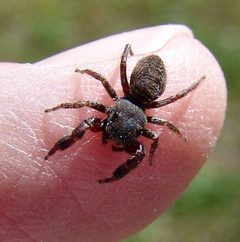
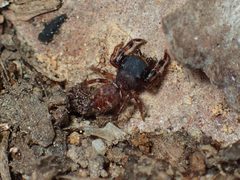
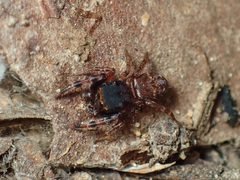
1- Ghelna canadensis(Three-lined Ground Jumping Spider)
Ghelna is a of small jumping spiders (Salticidae) to North America, described by Wayne Paul Maddison in 1996. The genus contains four distributed across Canada and the eastern and central United States. Unlike many related jumping spiders, Ghelna species are ground-dwelling rather than arboreal. Mature males are typically smaller than females and often display more distinct coloration.
Pronunciation
How to pronounce Ghelna: /ˈɡɛl.na/
These audio files are automatically generated. While they are not always 100% accurate, they are a good starting point.
Identification
Distinguished from the common Phidippus by the absence of iridescent and slower, less bouncy movement. The three longitudinal dark stripes on the of males (basis for the "Three-lined Ground Jumping Spider" for G. canadensis) are distinctive. Formerly classified under Metaphidippus; older references may use this synonym. Examination of structure confirms mature males. Ground-dwelling contrasts with arboreal relatives in Dendryphantina.
Images
Habitat
Ground-dwelling in open including lawns, prairies, meadows, and disturbed areas. Found on sidewalks, soil surfaces, and low vegetation. Unlike arboreal Dendryphantina, does not occupy trees or shrubs.
Distribution
North America: Canada and the United States. Eastern United States from the Great Lakes region south to Texas, excluding the southernmost tier of states. Western records include Minnesota (north) and near Dallas, Texas (south). -specific ranges: G. canadensis and G. sexmaculata in USA and Canada; G. barrowsi and G. castanea in USA only.
Seasonality
observed in late summer; G. canadensis recorded in Kansas in late August. Specific data for other is limited.
Behavior
Movement is notably slow and deliberate compared to the rapid, jumping locomotion typical of most salticids. Captive specimens have been observed to accept water from moistened cotton swabs, suggesting dehydration sensitivity. Ground-dwelling habit represents an ecological divergence from arboreal relatives.
Ecological Role
Ground-dwelling in open ; specific ecological functions undocumented.
Human Relevance
Occasionally encountered in urban and suburban environments (sidewalks, lawns). No documented economic or medical significance. Subject of science documentation via iNaturalist.
Similar Taxa
- PhidippusCommon sympatric jumping spider ; distinguished by iridescent , faster movement, and typically arboreal habit
- MetaphidippusFormer classification for G. canadensis; now recognized as distinct
More Details
Taxonomic History
G. canadensis was formerly placed in Metaphidippus; revision by Maddison established Ghelna in 1996
Species Diversity
Four recognized : G. barrowsi, G. canadensis, G. castanea (type species), and G. sexmaculata