
Eris rufa
(C. L. Koch, 1846)
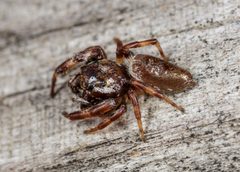
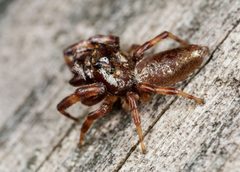
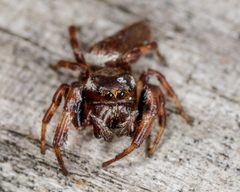
Eris rufa is a of jumping spider in the Salticidae, first described by Carl Ludwig Koch in 1846 as Plexippus rufus. The species was transferred to the Eris in 2004 when G. B. Edwards synonymized it with the previously described Eris pinea. It occurs in northeastern North America, with documented records from Canada and the United States. The specific epithet rufa refers to the reddish coloration of this small spider, with females measuring approximately 5.9 mm and males 5.7 mm in total body length.
Pronunciation
How to pronounce Eris rufa: /ˈɛrɪs ˈruːfə/
These audio files are automatically generated. While they are not always 100% accurate, they are a good starting point.
Identification
Males distinguished from similar Eris by the male structure: tibial is longer than but not as curved as in related species, and the embolus is shorter and arises farther from the retrolateral border. The distinctive leg coloration pattern on the first leg—particularly the dark with yellow tip and the bicolored patella/tibia—provides additional diagnostic characters. Females may be recognized by the combination of lighter , narrower build relative to males, and the light orange opisthosoma with yellow venter. The curved white band on the male carapace separates it from some , though detailed examination of genitalic structures is required for definitive identification.
Images
Appearance
Small jumping spider with sexually dimorphic coloration. Females: total body length approximately 5.9 mm; 2.4 mm long, 1.6 mm wide; narrower than males and generally lighter; overall color brown with white hairs distributed over carapace, particularly on and in patches between rear ; legs lighter than males with similar markings; opisthosoma light orange above and yellow beneath. Males: total length 5.7 mm; cephalothorax 2.62 mm long, 2.15 mm wide; opisthosoma 3 mm long, 1.7 mm wide; carapace brown above, darker along sides and declivity; curved band of white extends from lateral eyes, under small eyes, and onto declivity; opisthosoma with thin basal white line, remainder gray-brown with iridescent scales.
Distribution
Recorded from Canada and the United States. In the United States, documented from Connecticut, Massachusetts, and other northeastern states. Distribution records indicate presence in North America, with specific occurrences in the northeastern region of the continent.
Similar Taxa
- Eris militarisSimilar male structure; distinguished by differences in tibial curvature and embolus position
- Eris flavaOverlapping geographic range; requires examination of genitalic for separation
- Eris pineaJunior synonym based on specimens from Connecticut; synonymized with E. rufa by Edwards (2004) due to conspecificity
More Details
Taxonomic History
Originally described as Plexippus rufus by C. L. Koch in 1846. In 1945, B. J. Kaston described Paraphidippus pineus from Connecticut specimens, later transferred to Eris as Eris pinea. Edwards (2004) determined these represented the same , establishing Eris rufa as the valid name and synonymizing Eris pinea.
Etymology
The specific epithet rufa is Latin for 'red' or 'reddish', referring to the spider's characteristic coloration.