
Eris militaris
(Hentz, 1845)
Bronze Jumper, Bronze Lake Jumper
Eris militaris is a jumping spider in the Salticidae, commonly known as the bronze jumper or bronze lake jumper. It occurs in the United States and Canada in both suburban and rural settings. The exhibits in coloration and body size. It is active during autumn and winter, often seeking shelter in vegetation or under debris.
Pronunciation
How to pronounce Eris militaris: /ˈɛrɪs mɪlɪˈtɛərɪs/
These audio files are automatically generated. While they are not always 100% accurate, they are a good starting point.
Identification
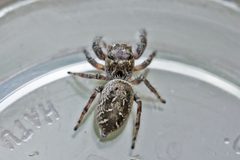
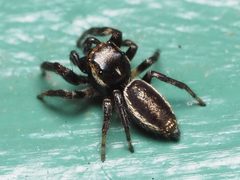
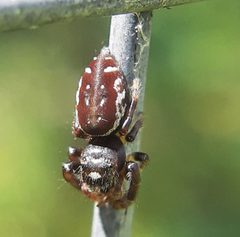
Distinguished from similar jumping spiders by the combination of bronze-brown coloration and in pattern: females with white spots on only, males with white lateral bands on and abdomen. Male are notably elongated. The ' autumn-winter activity period separates it from many temperate jumping spiders active in spring-summer.
Images
Appearance
Sexually dimorphic in size and coloration. Males measure 4.7–6.7 mm, females 6–8 mm. Females have a lighter and a slightly darker with white spots dorsally. Males have a darker cephalothorax, lighter abdomen, and white bands along the sides of the cephalothorax—bands absent in females. Males possess elongated at the front of the cephalothorax. Overall coloration is bronze, tan, or brown.
Habitat
Found in sheltered areas within vegetation, including overlapping leaves of blackberry bushes that create small shelters. Occurs in suburban and rural environments, including apple orchards. In autumn, frequently enters buildings. Aggregates beneath dead wood and other surfaces during colder months.
Distribution
United States and Canada. Records indicate presence across North America in temperate regions.
Seasonality
Active from autumn through winter. commonly observed inside and outside buildings during autumn. Aggregates in sheltered locations during winter.
Diet
Small insects including grasshoppers, , flies, other spiders, fruit flies, bees, , crickets, worms, butterflies, and leafhoppers. Prey size limited by what the can grasp.
Life Cycle
to development follows typical salticid pattern; specific duration not documented. Overwinters as adults in sheltered .
Behavior
Males perform involving lifting forelegs outward with consistent movement, occasionally stepping side to side. Post-feeding observed, with rubbed on . Grooming also occurs during rest periods in shelters. Forms beneath dead wood and other surfaces in autumn and winter. Exhibits camouflage behavior in sheltered locations.
Ecological Role
of small insects and other arthropods. In apple orchards, contributes to pest regulation. -level effects of exposure may reduce services in agricultural .
Human Relevance
Enters buildings in autumn, potentially causing minor nuisance. Subject of research on sublethal effects on spider and personality. In apple orchards, exposure to insecticides has been observed to alter spatial memory, learning ability, and prey capture behavior—with males more affected in environmental exploration and females in prey capture strength.
Similar Taxa
- Other Eris speciesSimilar body plan and coloration; requires examination of genitalia and specific pattern details for separation
- Other bronze-colored SalticidaeSimilar coloration; distinguished by specific pattern elements (white spots in females, lateral bands in males) and cheliceral
More Details
Insecticide sensitivity
Sublethal exposure in agricultural has been documented to alter individual behavioral traits, including decreased spatial memory and learning ability. Males and females show differential vulnerability: males exhibit greater impairment in environmental exploration, while females show reduced prey capture strength. These effects may have implications for services in orchards.
Sources and further reading
- BugGuide
- Wikipedia
- GBIF taxonomy match
- iNaturalist taxon
- NCBI Taxonomy
- Catalogue of Life
- Spiders Are Awesome! | Bug Squad
- To Bee or Not to Bee | Bug Squad
- A friendlier type of drone: Common Drone Fly, Eristalis tenax — Bug of the Week
- Bug Eric: Fly Day Friday: Rat-tailed Maggots
- Insect Migration (Part 1) - Buglife Blog - Buglife
- Mudo Pryfed (Rhan 1) - Buglife Blog - Buglife