
Admestina tibialis
(C. L. Koch, 1846)
Admestina tibialis is a small jumping spider in the Salticidae, first described by C. L. Koch in 1846. The is distinguished by sexually dimorphic , particularly the enlarged tibia of the first leg in males that gives the species its name. It occurs in coniferous forests across eastern North America, where it hunts as an active visual .
Pronunciation
How to pronounce Admestina tibialis: //ædˈmɛs.tɪ.nə taɪˈbiː.ə.lɪs//
These audio files are automatically generated. While they are not always 100% accurate, they are a good starting point.
Identification
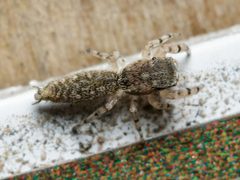
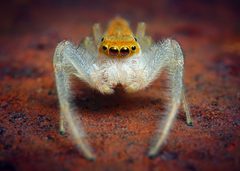
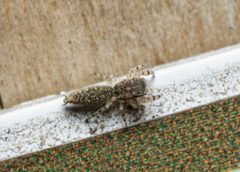
Distinguished from other Admestina and similar salticids by the enlarged tibia of the first leg, particularly pronounced in males. Male with strongly curved embolus and swollen bulb provides definitive identification. The tibialis directly references this diagnostic trait. Females may be harder to distinguish but share the -characteristic enlarged first leg segments. Patterned with central stripe and lateral extensions assists field recognition.
Images
Habitat
Coniferous forests, particularly among pines and spruces. Occupies forest floor and lower vegetation layers where it hunts actively.
Distribution
Eastern North America: New England south to North Carolina, west to Illinois and southwest to Texas. Recorded from Canada and throughout much of the eastern and central United States. iNaturalist records indicate presence from Florida to Connecticut.
Behavior
Active visual typical of salticid jumping spiders. Has been observed issuing from soil cracks during events, suggesting some association with ground-level or subterranean retreats.
Ecological Role
in coniferous forest floor , contributing to . Prey likely includes small insects and other arthropods typical of forest litter .
Human Relevance
No documented economic or medical significance. Too small to be conspicuous to non- observers. May be encountered by forest researchers and naturalists in appropriate .
Similar Taxa
- Other Admestina speciesShare -characteristic but lack the specific tibial enlargement and associated color dimorphism of A. tibialis; precise identification requires examination of male structure
- Other Salticidae in coniferous forestsMany small jumping spiders occupy similar ; A. tibialis distinguished by specific leg enlargement pattern and abdominal markings
More Details
Etymology
The specific epithet tibialis refers to the enlarged tibia of the first leg, particularly in males, which is a distinguishing characteristic of this .
Taxonomic history
First described by C. L. Koch in 1846, among early descriptions of North American jumping spiders.
Sources and further reading
- BugGuide
- Wikipedia
- GBIF taxonomy match
- iNaturalist taxon
- NCBI Taxonomy
- Catalogue of Life
- Bembicid Holdings | Entomology Research Museum
- Meloidae Holdings | Entomology Research Museum
- And Then There Were Three: New Termite Species Identified in California
- New Method Makes for Faster Genetic ID of Eastern U.S. Termites
- Western U.S. Has More Subterranean Termite Species Than Previously Thought, Study Shows
- Bug Eric: Termite Swarms