
Pisaurina dubia
(Hentz, 1847)
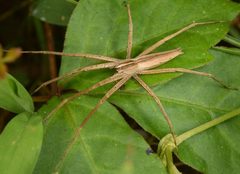
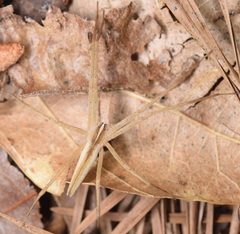
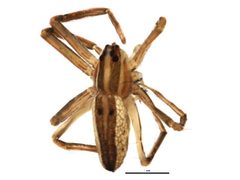
Pisaurina dubia is a nursery web spider in the Pisauridae, found across the southern two-thirds of the eastern United States. It is smaller than most pisaurids, measuring 12–15 mm in body length, and overwinters as a subadult before maturing in spring. The is distinguished by a central tuft of hair projecting from between the on the . Females construct nursery webs in vegetation to protect their sacs and guard spiderlings until they disperse.
Pronunciation
How to pronounce Pisaurina dubia: /piːˈsaʊrɪnə ˈdjuːbiə/
These audio files are automatically generated. While they are not always 100% accurate, they are a good starting point.
Identification
Distinguished from Pisaurina mira by smaller size (12–15 mm vs. 12.5–16.5 mm in P. mira females) and presence of the cephalic tuft. Distinguished from slender crab spiders (Tibellus spp., Philodromidae) by arrangement: Pisaurina has all eyes similar in size, while philodromids have a different eye pattern. Distinguished from wolf spiders (Lycosidae) by preference (vertical vegetation vs. ground-dwelling) and eye arrangement. The cephalic tuft of hair is the most reliable field mark for P. dubia.
Images
Habitat
Occurs in diverse including lawns, forest litter and understory, forest edges, barns on hay bales, exterior walls of buildings, pitcher plants, Spanish moss (Tillandsia usneoides), sugarcane fields, and low vegetation in wetlands. Unlike many nursery web spiders that require tall vegetation, this has been documented in maintained lawns. Generally associated with vegetation at least a few inches above ground for nursery web construction.
Distribution
Southern two-thirds of the eastern United States, from New Jersey south to Florida, and west to eastern Nebraska, Kansas, Oklahoma, and Texas. Records extend into the Great Plains region at the western edge of its range.
Seasonality
Overwinters as subadult; matures in spring. active from spring through summer. Mating occurs in mid-summer. Spiderlings emerge from nursery webs in late summer to autumn, in protected locations before dispersing the following spring.
Diet
Active hunting of insects and other small arthropods. Prey captured through ambush from vegetation or active pursuit. Has been observed hunting at artificial lights where insect prey congregate.
Life Cycle
Females produce sacs carried in the until suitable nursery web site is located. Nursery web constructed in vegetation, with egg sac suspended within. Female guards egg sac and emerging spiderlings until they complete one and disperse. Spiderlings overwinter in cracks, crevices, beneath bark, or in other protected locations. Developmental period from egg to spans approximately one year with at two life stages (subadult and spiderling).
Behavior
Hunting spider that does not construct prey-capture webs; builds only minimal scaffolding for resting and nursery webs for offspring. Sits motionless in ambush on vegetation during day and night. Responds quickly to motion, either attacking prey or fleeing from disturbance. Females exhibit maternal care by guarding sacs and spiderlings in nursery webs. Males use silk veil to bind female's first two pairs of legs during mating while both suspended from draglines.
Ecological Role
of insect pests in agricultural and suburban environments, including sugarcane fields and lawns. Serves as prey for larger predators including birds and other arthropods. Contributes to of herbivorous insects.
Human Relevance
Beneficial in gardens, lawns, and agricultural settings. Occasionally enters buildings but not considered a household pest. Not dangerously venomous to humans; bite unlikely unless handled. Presence indicates healthy . May be mistaken for more dangerous spiders due to size and speed.
Similar Taxa
- Pisaurina miraLarger with similar coloration and ; distinguished by larger size and absence of cephalic tuft; P. mira reaches adulthood in spring while P. dubia overwinters as subadult
- Tibellus spp. (Philodromidae)Slender crab spiders with similar elongated bodies and long legs; distinguished by different arrangement and lack of cephalic tuft; philodromids have two large eyes
- Wolf spiders (Lycosidae)Ground-dwelling hunting spiders with similar size and coloration; distinguished by arrangement (wolf spiders have two large eyes) and preference (ground vs. vertical vegetation)
More Details
Taxonomic history
Described by Nicholas Marcellus Hentz in 1847. The specific epithet 'dubia' (Latin for 'doubtful') may refer to initial uncertainty in its classification or the variable appearance of specimens.
Proposed common names
No widely accepted exists; 'Horned Nursery Web Spider' or 'Tufted Nursery Web Spider' have been suggested based on the distinctive cephalic tuft.
Regeneration
Documented ability to regenerate lost legs; regenerated legs are paler in color than original legs, providing evidence of previous injury.
Sources and further reading
- BugGuide
- Wikipedia
- GBIF taxonomy match
- iNaturalist taxon
- Catalogue of Life
- Bug Eric: A Nursery Web Spider, Pisaurina dubia
- Bug Eric: 2025 City Nature Challenge Recap for Kansas City Metro
- Befriend wasps and they will befriend you: Digger wasps, Scolia dubia and Scolia nobilitata — Bug of the Week
- Bug Eric: Spider Sunday: Nursery Web Spider