
Micropholcus
Deeleman-Reinhold & Prinsen, 1987
cellar spiders
Species Guides
1- Micropholcus fauroti(cellar spider)
Micropholcus is a of cellar spiders (Pholcidae) characterized by long legs and relatively fragile bodies. It is one of only two pholcid genera with both Old and New World distributions, though morphological and ecological differences exist between geographic groups. The genus currently contains at least 29 , with major taxonomic revisions in 2014 (transfers from Leptopholcus) and 2024 (description of twelve new Old World species). The type species M. fauroti has a pantropical distribution and has been introduced globally.
Pronunciation
How to pronounce Micropholcus: /maɪˌkroʊˈfɒlkəs/
These audio files are automatically generated. While they are not always 100% accurate, they are a good starting point.
Identification
Distinguished from other Pholcidae by combination of genitalic characters and molecular data. Old World and New World groups show major morphological differences, requiring dissection or for definitive identification. Males typically identified by structure; females by epigynal . CO1 barcodes have been used for species delimitation in recent revisions.
Images
Appearance
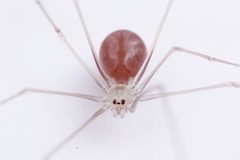
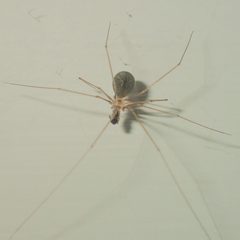
Long-legged, relatively fragile cellar spiders with oval . Eight arranged in two rows. Legs disproportionately long relative to body size, typical of Pholcidae. Body and leg proportions vary among groups.
Habitat
Tropical and subtropical regions; specific documented microhabitats include caves (Blue Water Cave in Philippines, Furna Feia cave in Brazil), sinkholes (Shaat sinkhole in Oman), wadis (Wadi Darbat in Oman), and semi-arid regions. M. fauroti is and occurs in human-modified environments.
Distribution
Pantropical distribution with in: Old World—Saudi Arabia, Oman, Morocco, Yemen, Philippines, Cameroon, Sri Lanka, Southeast Asia, Australia, Pacific Islands; New World—Greater Antilles (Hispaniola, Jamaica, Puerto Rico, Virgin Islands), Brazil, restricted USA (Tennessee, Georgia, Alabama). M. fauroti introduced to Europe (Belgium, Germany), Africa, and both Americas.
Host Associations
- Acroceridae (Diptera) - First records of Acroceridae larvae in Pholcidae; extracted from book lungs of Micropholcus specimens
Behavior
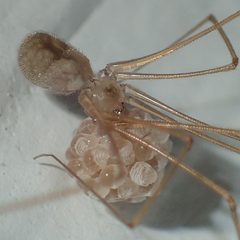
M. fauroti is and considered harmless to humans. Females carry -sacs, as observed in M. harajah, M. alfara, M. bashayer, and M. darbat.
Ecological Role
M. fauroti classified as / in Europe where it has established .
Human Relevance
M. fauroti is a harmless that has spread globally via human commerce. No medical or economic significance documented.
Similar Taxa
- LeptopholcusFormerly included now transferred to Micropholcus; distinguished by genitalic and molecular data
- PholcusBoth are long-legged cellar spiders; Micropholcus distinguished by specific genitalic characters and geographic distribution patterns
More Details
Taxonomic History
established in 1987. Major revision in 2014 transferred from Leptopholcus, increasing species count to 15. 2024 revision added twelve new Old World species from Saudi Arabia, Oman, Morocco, and Philippines. Molecular data was critical in maintaining genus unity despite morphological divergence between geographic groups.
Research Significance
First documentation of Acroceridae (Diptera) in Pholcidae, expanding knowledge of spider-parasitoid relationships. Extensive SEM and CO1 barcode data available for identification.
Sources and further reading
- BugGuide
- Wikipedia
- GBIF taxonomy match
- iNaturalist taxon
- NCBI Taxonomy
- Catalogue of Life
- Old World Micropholcus spiders, with first records of acrocerid parasitoids in Pholcidae (Araneae)
- Life History of the Pholcid Spider, Micropholcus fauroti (Simon, 1887) (Araneae: Pholcidae) in Egypt
- Aliens in Europe: updates on the distributions of Modisimus culicinus and Micropholcus fauroti (Araneae, Pholcidae)
- Supplementary material 1 from: Huber BA, Meng G (2024) Old World Micropholcus spiders, with first records of acrocerid parasitoids in Pholcidae (Araneae). ZooKeys 1213: 95-182. https://doi.org/10.3897/zookeys.1213.133178
- Figure 68 from: Huber BA, Meng G (2024) Old World Micropholcus spiders, with first records of acrocerid parasitoids in Pholcidae (Araneae). ZooKeys 1213: 95-182. https://doi.org/10.3897/zookeys.1213.133178
- Figure 43 from: Huber BA, Meng G (2024) Old World Micropholcus spiders, with first records of acrocerid parasitoids in Pholcidae (Araneae). ZooKeys 1213: 95-182. https://doi.org/10.3897/zookeys.1213.133178
- Figure 73 from: Huber BA, Meng G (2024) Old World Micropholcus spiders, with first records of acrocerid parasitoids in Pholcidae (Araneae). ZooKeys 1213: 95-182. https://doi.org/10.3897/zookeys.1213.133178
- Figure 22 from: Huber BA, Meng G (2024) Old World Micropholcus spiders, with first records of acrocerid parasitoids in Pholcidae (Araneae). ZooKeys 1213: 95-182. https://doi.org/10.3897/zookeys.1213.133178
- Figure 2 from: Huber BA, Meng G (2024) Old World Micropholcus spiders, with first records of acrocerid parasitoids in Pholcidae (Araneae). ZooKeys 1213: 95-182. https://doi.org/10.3897/zookeys.1213.133178
- Figure 45 from: Huber BA, Meng G (2024) Old World Micropholcus spiders, with first records of acrocerid parasitoids in Pholcidae (Araneae). ZooKeys 1213: 95-182. https://doi.org/10.3897/zookeys.1213.133178
- Figure 65 from: Huber BA, Meng G (2024) Old World Micropholcus spiders, with first records of acrocerid parasitoids in Pholcidae (Araneae). ZooKeys 1213: 95-182. https://doi.org/10.3897/zookeys.1213.133178
- Figure 13 from: Huber BA, Meng G (2024) Old World Micropholcus spiders, with first records of acrocerid parasitoids in Pholcidae (Araneae). ZooKeys 1213: 95-182. https://doi.org/10.3897/zookeys.1213.133178
- Figure 60 from: Huber BA, Meng G (2024) Old World Micropholcus spiders, with first records of acrocerid parasitoids in Pholcidae (Araneae). ZooKeys 1213: 95-182. https://doi.org/10.3897/zookeys.1213.133178
- Figure 54 from: Huber BA, Meng G (2024) Old World Micropholcus spiders, with first records of acrocerid parasitoids in Pholcidae (Araneae). ZooKeys 1213: 95-182. https://doi.org/10.3897/zookeys.1213.133178
- Figure 39 from: Huber BA, Meng G (2024) Old World Micropholcus spiders, with first records of acrocerid parasitoids in Pholcidae (Araneae). ZooKeys 1213: 95-182. https://doi.org/10.3897/zookeys.1213.133178