
Titanebo
Gertsch, 1933
Species Guides
1Titanebo is a of running crab spiders in the Philodromidae, first described by Gertsch in 1933. The genus comprises 14 distributed in the southwestern United States and Mexico. These spiders were historically classified under the genus Ebo but were reassigned to Titanebo based on taxonomic revision. They are characterized by their elongated second pair of legs, a distinctive trait among philodromid spiders.
Pronunciation
How to pronounce Titanebo: //ˌtiːtəˈneɪboʊ//
These audio files are automatically generated. While they are not always 100% accurate, they are a good starting point.
Identification
Distinguished from other Philodromidae by the extreme elongation of the second pair of legs, which is more pronounced than in related . Previously confused with Ebo, from which it was separated taxonomically; -level identification requires examination of genitalic characters. The combination of small body size and disproportionately long second legs is diagnostic for the genus.
Images
Appearance
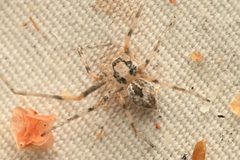
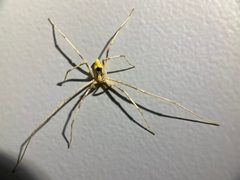
Small-bodied spiders with body lengths averaging 2–6 mm. The second pair of legs is dramatically elongated, typically at least twice the length of the other legs, giving these spiders an exceptionally wide 'wingspan' relative to their body size. The overall body form is slender and adapted for running.
Habitat
Found in arid and semi-arid environments of the southwestern United States and adjacent Mexico. Specific microhabitats include grasses, foliage, and ground-level vegetation. At least two have been documented in pecan groves in Texas.
Distribution
to North America, with range restricted to the United States and Mexico. Within the United States, occur primarily in the Southwest, with greatest diversity in Arizona, New Mexico, Texas, and California. Mexican species occur in northern Mexico.
Behavior
Active hunters that prowl for prey among grasses and foliage rather than building webs to capture prey. The elongated second legs are presumed to aid in rapid running and maneuvering through vegetation, though specific behavioral functions have not been experimentally verified.
Ecological Role
that contribute to in their . Documented occurrence in agricultural settings (pecan groves) suggests potential for minor natural pest control, though quantitative impact has not been assessed.
Human Relevance
Occasional incidental encounters in human dwellings, particularly in the southwestern United States. Potential minor benefit as natural in agricultural . No documented medical or economic significance.
Similar Taxa
- EboHistorically congeneric; separated based on taxonomic revision. Ebo sensu stricto now contains seven North American with less extreme leg elongation and different genitalic . Ebo also has broader geographic distribution including Canada, Argentina, India, and Russia, whereas Titanebo is restricted to the southwestern U.S. and Mexico.
- Other PhilodromidaeAll philodromids have the second pair of legs longest, but Titanebo exhibits the most extreme elongation of this trait among North American members of the .
More Details
Taxonomic history
The was established by Gertsch in 1933 but underwent significant revision when were reassigned from Ebo. This taxonomic split reflects improved understanding of phylogenetic relationships within Philodromidae. The type species is Titanebo macyi Gertsch, 1933.
Name etymology
The derivation of the name is not documented in the original description. The name appears to be an arbitrary combination without clear etymological reference.