
Thanatus rubicellus
Mello-Leitão, 1929
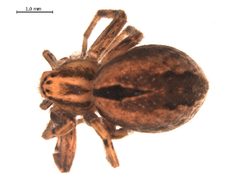
Thanatus rubicellus is a of running crab spider in the Philodromidae, first described by Mello-Leitão in 1929. Running crab spiders in the Thanatus are ground-dwelling hunters that overwinter as and become active in early spring. They are characterized by a robust body with longitudinal stripes on the and a dark cardiac mark on the . The species has been recorded from the United States and Canada, including Alberta.
Pronunciation
How to pronounce Thanatus rubicellus: /θəˈneɪtəs ˌruːbɪˈsɛləs/
These audio files are automatically generated. While they are not always 100% accurate, they are a good starting point.
Identification
Thanatus are distinguished from the more slender Tibellus (slender crab spiders) by their robust body build and different stripe pattern. Thanatus hunts primarily on the ground amid grasses and weeds, whereas Tibellus is almost always found on stems, stalks, grassblades, or leaves. Thanatus can be confused with wolf spiders in the Schizocosa, which share similar longitudinal stripes on the and a dark cardiac mark on the ; however, Thanatus has the characteristic laterigrade leg orientation of crab spiders.
Images
Habitat
Ground-dwelling including grasses and weeds; concrete or asphalt surfaces where spiders bask to warm themselves in cool spring weather.
Distribution
United States and Canada, including Alberta.
Seasonality
Active in spring; overwinter and emerge during early spring warming.
Life Cycle
Overwinters as .
Behavior
Basks on warm surfaces such as concrete paths to elevate body temperature. Has been observed attempting to balloon (aerial by silk) in late fall.
Ecological Role
.
Similar Taxa
- TibellusSlender crab spiders in the same (Philodromidae) that share similar coloration but have more elongated bodies, different stripe patterns, and occupy vegetation rather than ground .
- SchizocosaWolf spiders (Lycosidae) that share superficial resemblance in striping pattern and dark cardiac mark, but differ in characteristics including arrangement and leg orientation.