
Philodromus rufus
Walckenaer, 1826
white-striped running crab spider
Species Guides
4- Philodromus rufus jenningsi
- Philodromus rufus pacificus(Pacific running crab spider)
- Philodromus rufus quartus
- Philodromus rufus vibrans
Philodromus rufus is a Holarctic running crab spider in the Philodromidae. Laboratory studies indicate pronounced in predatory , with females killing approximately six times more prey than males. The exhibits a to prey influenced by prey activity levels. Five are recognized, including the nominate form and four regional variants in North America.
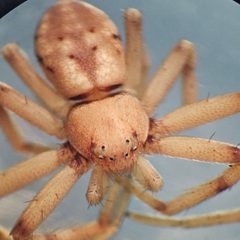
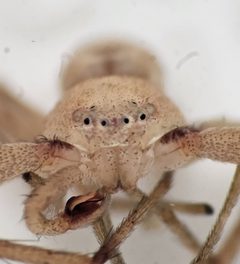
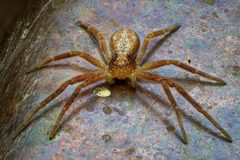
Pronunciation
How to pronounce Philodromus rufus: //ˌfɪloʊˈdroʊməs ˈruːfəs//
These audio files are automatically generated. While they are not always 100% accurate, they are a good starting point.
Identification
Distinguished from similar Philodromus by male courtship : males vibrate their legs during courtship and possess an angular retrolateral on the palpal tibia. The P. rufus vibrans is smaller and heavily speckled. Distinguished from P. exilis (eastern North America) by the latter's lack of leg vibration and non-angular palpal apophysis.
Images
Distribution
North America; Europe; Turkey; Caucasus; Russia (including Siberia); Central Asia; Kazakhstan; Iran; Mongolia; China; Korea; Japan.
Diet
; laboratory studies used Drosophila melanogaster as prey.
Life Cycle
spiders progress through molting periods to reach adulthood; molting strongly influences feeding rate.
Behavior
males exhibit relatively uniform feeding patterns and are inefficient compared to females, which show irregular feeding patterns. Courtship involves male leg vibration. Feeding rate is strongly influenced by periods of starvation, molting, and oviposition (in females). At high prey densities, uncaptured prey interfere with feeding spiders, creating an inverse relationship between hunger and individual prey utilization. Both feeding time and searching time vary with prey .
Ecological Role
; to prey demonstrated in laboratory conditions, with prey activity, predator feeding time, and rate of discovery as density-dependent parameters.
Similar Taxa
- Philodromus exilisOccurs in eastern North America (Great Lakes-St. Lawrence-Acadian forests); males lack leg vibration and have non-angular palpal
- Philodromus rufus vibrans; smaller body size and heavily speckled coloration
Sources and further reading
- BugGuide
- Wikipedia
- GBIF taxonomy match
- iNaturalist taxon
- NCBI Taxonomy
- Catalogue of Life
- 4th International Pollinator Conference Begins | Bug Squad
- Aspiring for Better Pollination | Bug Squad
- Here's the Buzz That Might Change How We Think | Bug Squad
- Clear the Calendar for the 2016 Pollinator Conference! | Bug Squad
- Why Wild Bees Are in Trouble | Bug Squad
- Free Webinars: Think of the ABCs in Pollination of Specialty Crops | Bug Squad
- Predatory Behavior of Philodromus rufus Walckenaer (Araneae: Thomisidae)
- SEXUAL BEHAVIOR AND THE CLASSIFICATION OF THE PHILODROMUS RUFUS COMPLEX IN NORTH AMERICA (ARANEIDA: THOMISIDAE)