
Ebo latithorax
Keyserling, 1884
running crab spider
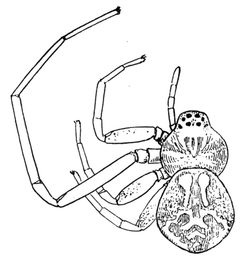
Ebo latithorax is a of running crab spider in the Philodromidae. It belongs to a characterized by exceptionally long second legs that are at least twice the length of the other legs, giving these small spiders an unusual 'wingspan' relative to their body size. The species is found in the United States and Canada, with records from Alberta, Manitoba, and Saskatchewan. Like other philodromids, it is an active hunter that prowls for prey among vegetation rather than building webs to capture food.
Pronunciation
How to pronounce Ebo latithorax: /ˈiːboʊ ˌlætɪˈθɔːræks/
These audio files are automatically generated. While they are not always 100% accurate, they are a good starting point.
Identification
The Ebo is distinguished from other running crab spiders (Philodromidae) by the extreme elongation of the second pair of legs, which are at least twice as long as legs I, III, and IV. This trait is diagnostic for the genus and immediately apparent even in small specimens. Ebo latithorax specifically may be distinguished from other Ebo by geographic range and subtle morphological differences, though species-level identification typically requires examination of genitalic structures. The spider should not be confused with the similar genus Titanebo, which was recently separated from Ebo and contains several former 'Ebo' species; Titanebo species may overlap in range and general appearance.
Images
Appearance
Small-bodied spider with the second pair of legs dramatically elongated—at least twice as long as the other legs. Body length typically 2–6 mm, with E. latithorax specimens likely falling toward the smaller end of this range. The Ebo has a distinctive 'all elbows' appearance due to the extreme leg proportions. Coloration and detailed body markings specific to E. latithorax are not well documented in available sources.
Habitat
Found among grasses and foliage where it actively hunts for prey. At least two Ebo frequent pecan groves in Texas, suggesting similar agricultural or semi-cultivated may be used by E. latithorax. The reaches greatest diversity in the southwestern United States, though E. latithorax has a more northerly distribution.
Distribution
Recorded from the United States and Canada. Specific Canadian provincial records include Alberta, Manitoba, and Saskatchewan. The appears to have a northern distribution within the , which is broadly distributed across the U.S. and extends into extreme southern Canada.
Diet
Active that hunts prey among vegetation. Specific prey records for E. latithorax are not available, but philodromid spiders generally capture small insects and other arthropods encountered on plants.
Behavior
Active hunter that prowls for prey rather than building capture webs. Typical of running crab spiders, it likely relies on speed and stealth to approach and seize prey. No specific behavioral observations for E. latithorax have been published.
Ecological Role
in grassy and foliar ; potential minor contributor to natural pest control in agricultural settings such as pecan groves, based on observations of .
Human Relevance
No direct human interactions documented. Related in the provide minor natural pest control in pecan .
Similar Taxa
- Titanebo speciesFormerly classified in Ebo; separated based on morphological differences. May overlap in range and general appearance, requiring careful examination for distinction.
- Other Philodromidae generaRunning crab spiders in such as Philodromus have less dramatically elongated second legs; leg proportions are diagnostic for Ebo.
More Details
Taxonomic history
The Ebo was established by German arachnologist Eugen von Keyserling in 1884. The name 'Ebo' appears to derive from a medieval German diminutive of 'Ebur,' meaning 'prince' or 'lord.' Recent taxonomic revisions have reassigned several North American formerly in Ebo to the genus Titanebo, leaving seven recognized species in Ebo sensu stricto in North America.
Genus-level characteristics
The Ebo is noted for having perhaps the greatest leg span relative to body size of any North American spider due to the extreme elongation of the second pair of legs.
Sources and further reading
- BugGuide
- Wikipedia
- GBIF taxonomy match
- iNaturalist taxon
- Catalogue of Life
- Ebony Grasshopper
- New eBook: The American Entomologist Poet's Guide to the Orders of Insects
- Bug Eric: January 2012
- social insects | Blog
- Bug Eric: Stealing Minds and Destroying Morale: LibGen, Meta, and AI
- December | 2022 | Beetles In The Bush