
Eidmannella pallida
(Emerton, 1875)
Pallid cave spider
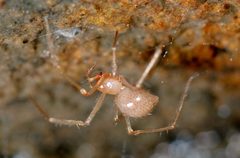
Eidmannella pallida is a scaffold-web spider in the Nesticidae with native distribution in North America and established across multiple global regions. The has been introduced to Pacific Islands, the Galápagos Islands, Macaronesia, Spain, Japan, and Italy, where it demonstrates high invasiveness potential. It readily establishes permanent populations in anthropogenic including vineyards, crop fields, and olive groves, and shows particular tendency to exploit vulnerable subterranean such as caves.
Pronunciation
How to pronounce Eidmannella pallida: //ˌaɪd.məˈnɛl.lə ˈpæl.ɪ.də//
These audio files are automatically generated. While they are not always 100% accurate, they are a good starting point.
Identification
Diagnostic morphological characters distinguish E. pallida from and other nesticids, though specific identification features require examination of detailed illustrations based on stereomicroscope and SEM imaging. The exhibits with distinct diagnostic characters in both males and females.
Images
Habitat
Vineyards, crop fields, olive groves, and subterranean environments including caves; shows strong association with crop-dominated landscapes and anthropogenic in invaded ranges.
Distribution
Native to North America; established in Pacific Islands, Galápagos Islands, Macaronesia, Spain, Japan, and Italy (North and South). Multiple new non-native localities recorded in recent years indicate ongoing range expansion.
Behavior
Exhibits high invasiveness potential with demonstrated ability to establish permanent in disturbed ; shows tendency to exploit vulnerable , particularly subterranean environments.
Ecological Role
Potential negative impacts on fauna in invaded areas, especially in cave where it may compete with or prey upon native .
Human Relevance
Recognized as an of concern in agricultural and conservation contexts; presence in vineyards and crop fields suggests potential interaction with agricultural systems, though specific economic impacts not documented.
Sources and further reading
- BugGuide
- Wikipedia
- GBIF taxonomy match
- iNaturalist taxon
- NCBI Taxonomy
- Catalogue of Life
- Those Incredible Digger Bees and Their Nest Parasites | Bug Squad
- Bees, Parasites and Maybe the End? | Bug Squad
- The Amazing Bee-Parasite Research of Leslie Saul-Gershenz | Bug Squad
- A Silver Digger Bee in Flight at Bodega Head | Bug Squad
- Congrats to Our UC Davis Nematologists! | Bug Squad
- Why Silver Digger Bees Are Like Gold | Bug Squad
- A comprehensive update on the morphology and distribution of the invasive scaffold-web spider Eidmannella pallida (Araneae, Nesticidae) with a focus on new records from Italy