
Zora
C. L. Koch, 1847
Species Guides
2- Zora hespera(prowling spider)
- Zora pumila
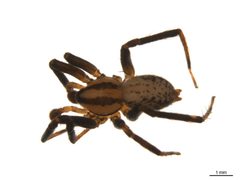
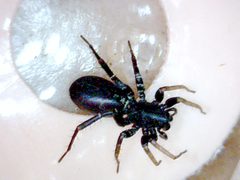
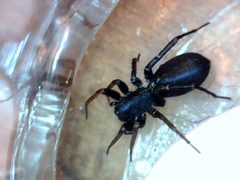
Zora is a of small to medium-sized spiders in the Miturgidae. These entelegyne, ecribellate spiders are characterized by two claws with claw tufts, distinct longitudinal bands on the , an 4-2-2 arrangement, and long overlapping spines on the first two tibiae and . The genus contains 17 described with showing distinct color patterns useful for species identification. The genus was established by C. L. Koch in 1847 and has historically been placed in the family Zoridae, though modern classifications assign it to Miturgidae.
Pronunciation
How to pronounce Zora: /ˈzɔːrə/
These audio files are automatically generated. While they are not always 100% accurate, they are a good starting point.
Identification
Members of Zora can be distinguished from similar spiders by the combination of two claws with claw tufts, distinct longitudinal bands on the , eight arranged in a 4-2-2 pattern, and long overlapping spines on the first two tibiae and . The displays distinct color patterns that may assist in -level identification.
Images
Distribution
Records exist from Denmark (DK), Norway (NO), and Sweden (SE), suggesting a primarily Palearctic distribution in northern Europe.
Misconceptions
The has been historically classified in the Zoridae, but modern taxonomic sources (iNaturalist, Catalogue of Life, GBIF) place it in Miturgidae. This discrepancy between older literature (including NCBI) and current classifications may cause confusion.
More Details
Taxonomic note
NCBI still lists Zora under Zoridae, while iNaturalist, GBIF, and Catalogue of Life have reassigned it to Miturgidae. This reflects ongoing revisions in spider family-level classification.
Observation data
As of available records, the has 1,845 observations documented on iNaturalist, indicating it is moderately well-documented in citizen science databases.
Sources and further reading
- BugGuide
- Wikipedia
- GBIF taxonomy match
- iNaturalist taxon
- NCBI Taxonomy
- Catalogue of Life
- Beetle, orthop or something else? | Beetles In The Bush
- paleoentomology | Beetles In The Bush
- [No taxon] | Beetles In The Bush | Page 5
- 2018 New Mexico/Texas Insect Collecting Trip “iReport” | Beetles In The Bush
- December | 2012 | Beetles In The Bush | Page 2
- Hurston, Zora Neale
- Zora Neale Hurston and the Speakerly Text