
Geolycosa hubbelli
Wallace, 1942
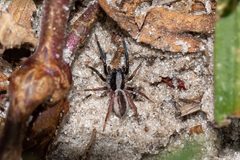
Geolycosa hubbelli is a of burrowing wolf spider in the Lycosidae. It is found in the United States and belongs to a characterized by deep, silk-lined burrows. Members of this genus are typically associated with sandy or loose soil where they construct vertical burrows with debris-reinforced turrets.
Pronunciation
How to pronounce Geolycosa hubbelli: //dʒiːoʊlaɪˈkoʊsə hʌˈbɛlaɪ//
These audio files are automatically generated. While they are not always 100% accurate, they are a good starting point.
Identification
Geolycosa hubbelli can be distinguished from other wolf spiders by its burrowing lifestyle and associated morphological adaptations, including stout front legs adapted for digging and a that is elevated anteriorly. The Geolycosa is separated from other Lycosidae by these structural features combined with their distinctive burrow construction. Specific identification to level requires examination of detailed morphological characters, particularly of the male and in females.
Images
Habitat
Sandy or loose soil in open areas with sparse vegetation. Like other Geolycosa , it constructs deep, vertical, silk-lined burrows with turrets reinforced with debris at the surface.
Distribution
United States. Distribution records indicate presence in North America, specifically the USA.
Behavior
Constructs and maintains deep burrows, with vertical shafts that can extend a meter or more in depth for individuals. Summer burrows are typically shallower, averaging 20–25 centimeters. The spider spends the majority of its life inside the burrow, with males wandering in late summer or early autumn to seek mates.
Similar Taxa
- Geolycosa missouriensisShares the burrowing habit, stout digging legs, and elevated characteristic of the . G. missouriensis has a broad Great Plains distribution and is the most frequently encountered Geolycosa in that region, making it a likely confusion partner for other Geolycosa species.
- Hogna speciesLarge wolf spiders that may be encountered in similar . Hogna lack the pronounced elevation of the and do not construct the deep, turreted burrows characteristic of Geolycosa.