
Tenuiphantes tenuis
(Blackwall, 1852)
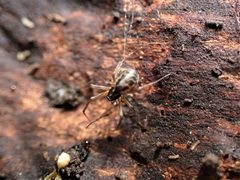
A minute sheet-web spider native to Europe, Macaronesia, Northern Africa, Turkey, the Caucasus, and Central Asia. It has been introduced to the USA, Chile, Argentina, and New Zealand. measure 2–3 mm in body length and are characterized by a dark brown , brown legs without annulations, and a slender often bearing distinctive black spots. The inhabits low vegetation, moss, and leaf litter.
Pronunciation
How to pronounce Tenuiphantes tenuis: /tɛˌnjuːɪˈfæntiːz ˈtɛnjuːɪs/
These audio files are automatically generated. While they are not always 100% accurate, they are a good starting point.
Identification
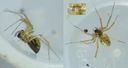
Distinguished from other Linyphiidae by its more slender body form and the distinctive black-spotted abdominal pattern. The absence of leg annulations and uniformly brown legs separate it from many . Minute size (2–3 mm) and dark brown are consistent field characters.
Images
Habitat
Low vegetation, moss, and leaf litter.
Distribution
Native to Europe, Macaronesia, Northern Africa, Turkey, Caucasus, and Central Asia. Introduced to USA, Chile, Argentina, and New Zealand.
Diet
Feeds on various insects including Listronotus bonariensis.
Ecological Role
of small insects in ground and low vegetation .
Human Relevance
Introduced in USA, Chile, Argentina, and New Zealand suggest potential as a non-native in these regions, though specific impacts have not been documented.
Similar Taxa
- Other Linyphiidae speciesT. tenuis is more slender with distinctive black-spotted abdominal pattern and lacks leg annulations
- Tenuiphantes congenersRequires examination of genitalia and detailed abdominal pattern for definitive separation; T. tenuis specifically noted for slender build and clear black spots on