
Neriene clathrata
(Sundevall, 1830)
Latticed Sheet-web Weaver
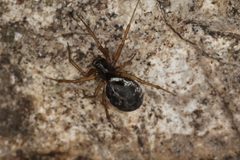
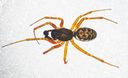
Neriene clathrata is a sheetweb spider in the Linyphiidae, commonly known as the Latticed Sheet-web Weaver. The has an exceptionally wide geographic distribution spanning the Holarctic region, occurring across North America, Europe, North Africa, the Caucasus, Russia (from European to Far East), China, Korea, and Japan. Despite its broad range, detailed biological information remains limited. As a member of the Linyphiidae, it constructs sheet webs rather than orb webs.

Pronunciation
How to pronounce Neriene clathrata: //nɛˈriː.ɛ.nɛ klæˈθreɪ.tə//
These audio files are automatically generated. While they are not always 100% accurate, they are a good starting point.
Identification
As a member of the Neriene, this can be distinguished from other sheetweb weavers by its latticed or clathrate (grid-like) abdominal pattern, which gives the species its specific epithet. Definitive identification to species level typically requires examination of genitalia: males possess complex with species-specific embolus and bulb structures, while females have a sclerotized with characteristic copulatory duct and spermatheca configurations. The spider is small-bodied, consistent with most Linyphiidae.
Images
Distribution
North America, Europe, North Africa, Caucasus, Russia (European to Far East), China, Korea, and Japan. GBIF records also document the from the Azores (Corvo, Faial, Flores, Pico, São Jorge).
Similar Taxa
- Neriene radiataAnother widespread Neriene with overlapping distribution; distinguished by different abdominal pattern and genitalia structure
- Frontinella communisAlso a linyphiid sheetweb weaver with similar small size and preferences; distinguished by its distinctive bowl-and-doily web architecture and bold black-and-white abdominal stripes