
Lepthyphantes
Menge, 1866
dwarf spiders
Species Guides
2- Lepthyphantes leprosus(Household Fine Sheetweaver)
- Lepthyphantes turbatrix
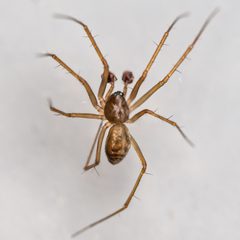
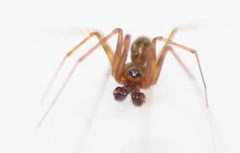
Lepthyphantes is a of dwarf spiders in the Linyphiidae, containing 144 and one as of October 2025. Species in this genus are found across Africa, Asia, Europe, and North America. The genus is notable for its members' adaptations to ephemeral and agricultural , with documented strategies emphasizing high reproductive rates and capabilities.
Pronunciation
How to pronounce Lepthyphantes: //lɛpˈθɪfəntiːz//
These audio files are automatically generated. While they are not always 100% accurate, they are a good starting point.
Images
Habitat
in this have been documented in ephemeral and agricultural fields, including winter wheat fields in England. Lepthyphantes flavipes has been observed on the upper surface of deciduous forest litter.
Distribution
Africa; Asia; Europe; North America (including Vermont, United States). Specific distribution records exist for Denmark, Norway, and Sweden.
Diet
Lepthyphantes tenuis has been identified as a capable of consuming aphids, including Rhopalosiphum padi. to consumption varies within and can be subject to selection.
Life Cycle
Lepthyphantes tenuis exhibits two to three per year in agricultural , with three peaks of hatchling production annually. development is temperature-related. The number of eggs per egg-sac does not vary with season, and there is no evidence that viable eggs per egg-sac vary seasonally.
Behavior
Members of this build sheet-webs. Lepthyphantes tenuis exhibits high activity, particularly in females, which increases with age. Dispersal activity ratios (activity/field ) are highest in females (4), followed by sub- (3), males (2), and immatures and hatchlings (1 each). Female dispersal is strongly correlated with weather conditions; under suitable conditions, approximately 4% of adult females may leave the daily. Lepthyphantes flavipes employs a fixed-site foraging strategy in good web sites or when fat reserves are high, switching to mobile strategies in poor sites at low reserves. Physical perturbations such as falling leaves interrupt fixed-site foraging and trigger movement.
Ecological Role
of aphids in agricultural systems. may contribute to natural limitation of .
Human Relevance
Lepthyphantes tenuis is used as a model organism for studying non-target effects of herbicides; glyphosate has been shown to have minimal direct but indirect effects through modification. The has been subject to artificial selection studies to demonstrate genetic variation in , with implications for potential in pest management.
Sources and further reading
- BugGuide
- Wikipedia
- GBIF taxonomy match
- NCBI Taxonomy
- Catalogue of Life
- Optimal Foraging Strategy of the Sheet‐Web Spider Lepthyphantes Flavipes Under Perturbation
- Artificial selection for aphid tolerance in the polyphagous predatorLepthyphantes tenuis
- Population dynamics and dispersal of Lepthyphantes tenuis in an ephemeral habitat
- The effect of the herbicide glyphosate on non‐target spiders: Part II. Indirect effects on Lepthyphantes tenuis in field margins
- The effect of the herbicide glyphosate on non‐target spiders: Part I. Direct effects on Lepthyphantes tenuis under laboratory conditions