
Zelotes subterraneus
(C. L. Koch, 1833)
Ground spider
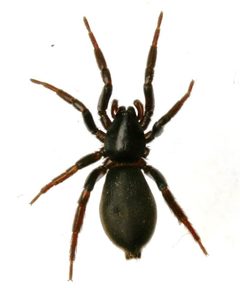
Zelotes subterraneus is a ground spider in the Gnaphosidae and the type of the Zelotes. It has a Palearctic distribution across Europe, Asia, and North Africa. The species is notoriously difficult to identify, particularly females, due to striking similarity with Zelotes apricorum and Zelotes latreillei. Males can be distinguished by examination of embolus structure on the . Body length ranges from 3.8-7.8 mm in males and 5.8-9.2 mm in females. It is an active hunter that does not build webs for prey capture.
Pronunciation
How to pronounce Zelotes subterraneus: //zɛˈloʊtiːz ˌsʌbtəˈreɪniəs//
These audio files are automatically generated. While they are not always 100% accurate, they are a good starting point.
Identification
Definitive identification requires microscopic examination of male genitalia, specifically the embolus tip on the . Females are extremely similar to Zelotes apricorum and Zelotes latreillei and cannot be reliably distinguished by external alone. The three may form a cryptic with possible hybridization in some areas, though this remains disputed. Specimens from Britain historically identified as Z. apricorum may include misidentified Z. subterraneus.
Images
Habitat
In Great Britain, restricted to two distinct types: montane areas under stones in northern mountains, and coastal shingle habitats in the southeast. Across continental Europe, occupies broader range including woodland, heathland, dry meadows, boggy areas, occurring under stones, bark, and in litter layers from sea level to 1300 m elevation.
Distribution
Palearctic distribution spanning Europe, Cyprus, Turkey, Caucasus, Russia (European to Far East), Central Asia, and China. In Europe, more frequently recorded in northern regions including Belgium, Netherlands, Denmark, Norway, and Sweden. In Great Britain, documented from mountains of central and eastern Scotland, northern England, and coastal southeast England. Distribution extends farther north and east than Z. apricorum on the continent.
Seasonality
of both sexes active in two periods: late spring through early summer, and late summer through autumn. This bimodal activity pattern suggests possible partial second or extended period.
Diet
Active of terrestrial arthropods including other small spider . Hunting occurs at night.
Life Cycle
involves white sacs attached to undersides of stones, guarded by the female until spiderlings emerge. Development includes egg, spiderling, and stages. Multiple per year possible given bimodal adult activity pattern, though detailed remains incompletely documented.
Behavior
, hunter that actively pursues and runs down prey rather than building capture webs. Females exhibit maternal guarding of sacs. Rapid ground-dwelling movement typical of gnaphosid spiders.
Ecological Role
contributing to regulation of soil and ground-surface . Prey includes other spiders, suggesting intraguild role in ground-dwelling arthropod .
Human Relevance
No direct economic or medical significance. Serves as for conservation assessment, particularly in Britain where restricted distribution highlights conservation value of montane and coastal shingle . Taxonomic difficulty with complicates ecological monitoring and distribution mapping.
Similar Taxa
- Zelotes apricorumExternally identical females; males distinguished by embolus structure. Historically confused in Britain where Z. subterraneus records likely underrepresented due to misidentification. Continental distribution tends south and west of Z. subterraneus.
- Zelotes latreilleiThird member of cryptic all-black Zelotes complex; females indistinguishable by external . Male genitalia examination required for separation.
Misconceptions
Historical British records of Z. apricorum likely include substantial numbers of misidentified Z. subterraneus, leading to underestimation of true distribution. Apparent hybridization between Z. subterraneus and Z. apricorum reported in some areas remains disputed, with alternative explanation of natural morphological variation.
More Details
Taxonomic significance
Type of Zelotes, making accurate identification critical for genus-level nomenclatural stability.
Identification challenges
The illustrates fundamental difficulties in spider where morphological convergence obscures boundaries, requiring integrative approaches combining genital , molecular data, and distributional .
Sources and further reading
- BugGuide
- Wikipedia
- GBIF taxonomy match
- iNaturalist taxon
- NCBI Taxonomy
- Catalogue of Life
- Novel research seeking to solve environmental challenges
- Conservation Translocations: It’s Not Just Beavers - Buglife Blog - Buglife
- BioRisk | Blog - Part 2
- Bug Eric: September 2012
- Pensoft Editorial Team | Blog - Part 50
- ecosystem services | Blog - Part 2