
Sergiolus columbianus
(Emerton, 1917)
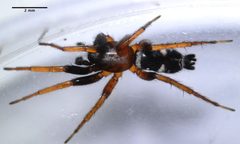
Sergiolus columbianus is a ground spider in the Gnaphosidae, native to western North America. It is one of approximately sixteen Sergiolus found north of Mexico. Like other members of its , it displays bold coloration that may serve as mimicry of velvet ants (Mutillidae). It is a nomadic hunter that does not construct prey-capture webs.
Pronunciation
How to pronounce Sergiolus columbianus: //sɛrˈdʒoʊləs ˌkoʊləmˈbiːənəs//
These audio files are automatically generated. While they are not always 100% accurate, they are a good starting point.
Identification
Distinguished from other colorful spiders by the prominent cylindrical at the tip, characteristic of all Gnaphosidae. Separation from other gnaphosid such as Callilepis requires examination of genitalia: the in females and in males. Distinguished from congeneric by subtle morphological details in genital structure; specific identification often requires expert examination.
Images
Appearance
Medium-sized spider with striking coloration typical of the . Body length approximately 6–10 mm for females, 5.5–7 mm for males. Displays bold, contrasting patterns that may include red, black, and white markings. Cylindrical at the tip of the are prominent and characteristic of Gnaphosidae. in size is present, with females larger than males.
Habitat
Found in sun-dappled patches on forest floors, particularly in deciduous forests. Also occurs in gardens, meadows, lawns, and reasonably dry situations under stones and other objects. Frequently observed on foliage and walls due to strong climbing ability. Often found in leaf litter where it prowls for prey.
Distribution
Western North America. Documented from the United States and Canada, including the provinces of Alberta and British Columbia. Range overlaps with but is distinct from the more eastern S. capulatus.
Seasonality
can be found in almost any season, with peak activity during warmer months. Observations span from early spring (April) through late autumn (November), with winter records from indoor or protected situations.
Life Cycle
Females construct silk retreats for molting, guarding sacs, and possibly . Does not spin prey-capture webs. Lifespan likely exceeds one year based on year-round presence.
Behavior
and highly active during daylight hours. Nomadic hunter that prowls through leaf litter and vegetation rather than building webs. Extremely agile and rapid when fleeing potential danger; may disappear quickly when disturbed but often reappears if observer remains patient. Strong climber frequently found on foliage, walls, and other vertical surfaces. Does not construct prey-capture webs but builds silk retreats for molting, guarding, and .
Ecological Role
Predatory ground spider contributing to control in forest floor and garden . Potential Batesian mimic of velvet ants (Mutillidae), which may confer protection from .
Human Relevance
Occasionally enters homes and buildings, where it attracts attention due to distinctive appearance. Not medically significant. Can be maintained in captivity with minimal care; requires water source and occasional feeding with small insects. Sometimes mistaken for velvet ants due to coloration, causing alarm.
Similar Taxa
- Sergiolus capulatusEastern with similar coloration and preferences; ranges overlap minimally with S. columbianus
- Sergiolus montanusWestern found in similar ; distinguished by subtle genitalic differences
- Callilepis gnaphosid with similar bold coloration; distinguished by genitalic structure
- Mutillidae (velvet ants)Wingless that S. columbianus may mimic; distinguished by six legs, , and lack of
More Details
Taxonomic History
Originally described as Poecilochroa columbianus by Emerton in 1917; transferred to Sergiolus. Older references may use the former name.
Mimicry Hypothesis
The bold coloration is suspected to represent mimicry of velvet ants (Mutillidae), which possess a potent sting. This putative remains incompletely studied.
Captive Maintenance
Readily kept in simple containers with water source (cotton wick recommended) and occasional prey. Spiders may refuse food prior to molting. Prey should be removed if not consumed within two days.