
Scotophaeus blackwalli
(Thorell, 1871)
Mouse Spider
Scotophaeus blackwalli, commonly called the mouse spider, is a ground-dwelling spider in the Gnaphosidae. It is native to Europe, the Caucasus, Turkey, and Iran, and has been introduced to North America, Peru, and Hawaii. The is and does not build webs for prey capture, instead hunting actively or scavenging opportunistically. It is frequently found in and around human dwellings, particularly in Britain during autumn.
Pronunciation
How to pronounce Scotophaeus blackwalli: //skɒtoʊˈfiːəs ˈblækwɔːlaɪ//
These audio files are automatically generated. While they are not always 100% accurate, they are a good starting point.
Identification
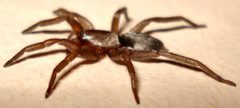
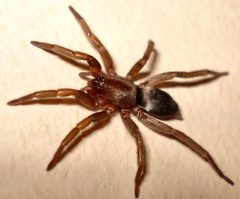
Distinguished from similar ground spiders by the combination of: dense mouse-like on the ; dark brown contrasting with lighter brown-grey abdomen; absence of a web; and hunting . The male's abdominal is a diagnostic feature. Distinguished from the unrelated Australian 'mouse spiders' (Missulena spp., Actinopodidae) by smaller size, different body proportions, and geographic range.
Images
Appearance
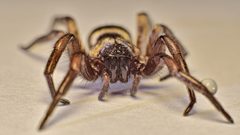
males reach approximately 9 mm in length, while females reach 12 mm. The is dark brown. The is brown to grey with dense hairs that resemble the body of a mouse, giving the its . Legs are brown with thick . Males possess a small on the surface of the abdomen.
Habitat
Found in and around human dwellings, especially houses in Britain. Occurs under bark and in holes in walls in warmer parts of Europe. Ground-dwelling; does not construct aerial webs.
Distribution
Native to Europe, the Caucasus, Turkey, and Iran. Introduced to North America, Peru, and Hawaii. Established recorded on São Miguel and Terceira (Azores).
Seasonality
Males mature in early summer. Females persist until autumn. In Britain, commonly encountered in autumn.
Diet
Active of insects and other spiders. Opportunistic scavenger.
Life Cycle
Females construct protective silk nests for their . Detailed developmental stages not documented in available sources.
Behavior
hunter that does not build capture webs. Uses enlarged to produce sticky silk for subduing prey. Females use silk to construct nests.
Ecological Role
and scavenger in ground-dwelling . Contributes to control of insects and other spiders.
Human Relevance
Frequently found inside houses; generally considered harmless to humans. derives from perceived resemblance to a mouse when viewed from above.
Similar Taxa
- Missulena spp.Australian 'mouse spiders' share but belong to unrelated Actinopodidae; larger, more robust, with different geographic distribution and potentially medically significant venom.
- Other GnaphosidaeMany ground spiders lack the distinctive dense mouse-like abdominal and male characteristic of S. blackwalli.
Misconceptions
The 'mouse spider' may cause confusion with the unrelated and potentially dangerous Australian mouse spiders (Missulena spp., Actinopodidae). S. blackwalli is not a significant threat to humans.
More Details
Subspecies
Two recognized: S. b. isabellinus (Corsica, Italy, Croatia) and S. b. politus (France).
Silk use
Unlike web-building spiders, S. blackwalli uses silk primarily for prey subjugation (via enlarged ) and nest construction rather than prey capture.