
Herpyllus propinquus
(Keyserling, 1887)
Western Parson Spider
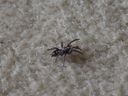
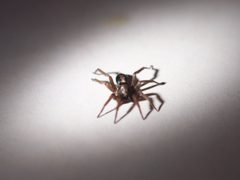
Herpyllus propinquus, commonly known as the western parson spider, is a ground spider in the Gnaphosidae. It is the western North American counterpart to the eastern parson spider (H. ecclesiasticus), replacing it west of the Rocky Mountains. This is primarily and has been observed climbing vertical surfaces with ease. It occasionally enters buildings, where it may be encountered by humans.
Pronunciation
How to pronounce Herpyllus propinquus: //hɜːˈpɪləs proʊˈpɪŋkwəs//
These audio files are automatically generated. While they are not always 100% accurate, they are a good starting point.
Identification
Distinguished from the eastern parson spider (Herpyllus ecclesiasticus) by geographic range: H. propinquus occurs west of the Rocky Mountains while H. ecclesiasticus occurs east of them. Distinguished from other ground spiders by the distinctive black and white 'parson' color pattern and prominent .
Images
Habitat
Deciduous woodlands; dry mixed conifer forest with oaks at higher elevations; found around buildings at night where it preys on insects attracted to lights
Distribution
Western North America, west of the Rocky Mountains; recorded from Canada (Alberta, British Columbia), USA, and Mexico
Seasonality
Mature specimens can be found year-round; nocturnally active
Diet
Small insects; has been observed preying on insects attracted to outdoor lights
Life Cycle
Mated females spin a flat sac in autumn, deposited in a silken retreat where the mother guards it (inferred from congeneric H. ecclesiasticus)
Behavior
; prowls at night; climbs well and can be seen well off the ground; hides under loose bark, stones, boards, and debris by day; capable of climbing virtually any surface including slick vertical substrates; fast-moving
Ecological Role
of small insects
Human Relevance
Occasionally enters homes, where it may seek in clothing, shoes, and other objects; may bite if trapped but rarely causes more than mild inflammation depending on individual immune response; not dangerous to healthy humans
Similar Taxa
- Herpyllus ecclesiasticusEastern parson spider, nearly identical in appearance but occurs east of the Rocky Mountains; replaced by H. propinquus in the west
More Details
Geographic replacement
Forms a classic east-west pair with H. ecclesiasticus, with the Rocky Mountains serving as the approximate boundary between their ranges