
Emblyna sublata
(Hentz, 1850)
mesh web weaver
Emblyna sublata is a of mesh web weaver spider in the Dictynidae. It was first described by Nicholas Marcellus Hentz in 1850. The species is known from North America, with records from the United States, Canada, and Mexico. As a dictynid spider, it constructs irregular mesh webs rather than the spiral orb webs typical of many other spider families.
Pronunciation
How to pronounce Emblyna sublata: /ɛmˈblɪnə sʌˈbleɪtə/
These audio files are automatically generated. While they are not always 100% accurate, they are a good starting point.
Identification
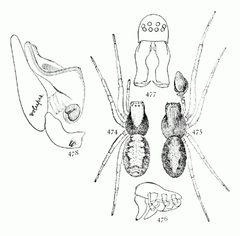
Members of Emblyna can be distinguished from other dictynid by genitalic characters, particularly the structure of the male and female . Emblyna sublata specifically requires examination of these structures for definitive identification. The genus generally includes small to medium-sized spiders with compact bodies and relatively short legs compared to some other web-building spiders.
Images
Distribution
Recorded from the United States, Canada, and Mexico. Specific locality data within these countries is sparse in available sources.
Behavior
Constructs mesh webs, a characteristic of the Dictynidae. These webs are irregular, three-dimensional networks of silk rather than flat, geometric orb webs.
Similar Taxa
- Other Dictynidae generaRequire genitalic examination to distinguish from Emblyna; external alone is often insufficient for identification to level in this .
- Other Emblyna speciesMorphologically similar and require detailed examination of reproductive structures for -level identification.