
Ctenus
Walckenaer, 1805
Tropical Wandering Spiders
Species Guides
4- Ctenus captiosus(Florida false wolf spider)
- Ctenus exlineae(Arkansas wandering spider)
- Ctenus hibernalis(Alabama wandering spider)
- Ctenus valverdiensis
Ctenus is a of wandering spiders in the Ctenidae, first described by Walckenaer in 1805. It comprises approximately 155 with a broad distribution spanning South America, Africa, and East Asia. Species in this genus are abundant in tropical rainforest leaf litter, where they serve as active and have become model organisms for studying predator in ground-dwelling . Some species, particularly C. medius, possess venom with documented proteolytic, hyaluronidase, and phospholipase activities, with potential medical significance due to complement system interference.
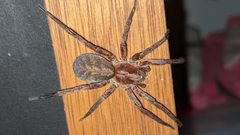
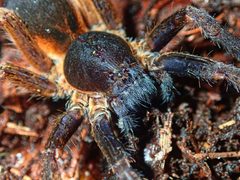
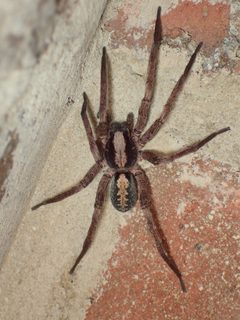
Pronunciation
How to pronounce Ctenus: /ˈktiːnəs/
These audio files are automatically generated. While they are not always 100% accurate, they are a good starting point.
Identification
Members of Ctenus can be distinguished from other wandering spider by morphological features detailed in taxonomic redescriptions, including specific arrangements of rows and genitalic structures. C. medius and C. ornatus longer than 3 mm width can be distinguished by chromatic patterns. Males and females of C. medius develop distinctly different color patterns during the last two instars, allowing sex determination without microscopic examination. The genus is placed in Cteninae, distinguished from other ctenid subfamilies by morphological characters of the male palp and other somatic features.
Images
Habitat
Tropical rainforests, primarily in leaf litter (serapilheira) of the forest floor. In the Amazon basin, found in terra-firme (non-flooded) upland forests on plateau areas. Occurs in primary continuous forest, forest fragments of varying sizes (1-100 ha), forest edges, and secondary forests. C. medius specifically prefers ecotopes characterized by dense shrub vegetation or herbal undergrowth, avoiding open sites.
Distribution
Widely distributed from South America through Africa to East Asia. In the Neotropics, abundant in Amazonian forests of Brazil, with records from Venezuela, British Guiana, and Bolivia. African distribution includes tropical rainforest regions. Asian records include India and Southeast Asia. Specific localities include Central Amazonia north of Manaus, Barra Mansa in the Brazilian Atlantic Forest, and the National Park of Itatiaia.
Life Cycle
For C. medius: females deposit sacs and remain with them until spiderling , which occurs approximately 36 days after oviposition in field conditions. The female abandons the site 7 days after emergence, coinciding with spiderling and onset of feeding. Spiderlings develop through multiple instars; sexual maturity is reached at the 14th or 15th instar after 309-345 days on average. Laboratory mortality rate to sexual maturity is 85%. among early instars (1st-4th) is absent when sufficient food is provided.
Behavior
Active wandering hunters in leaf litter, not web-building . Females exhibit maternal care by guarding sacs until spiderling . Spiderlings disperse from the natal site approximately 7 days after emergence. Males of C. longipes deposit bridal veils during sexual . The shows rapid response to environmental modifications, with fragmentation effects diminishing as secondary forest regenerates around fragments. Courtship movements have been observed in males, though successful mating in laboratory conditions has been difficult to induce.
Ecological Role
in leaf litter , serving as a model organism for understanding predator in tropical forest floor . Potential bioindicators of environmental quality and forest status, given their demonstrated sensitivity to fragmentation and subsequent recovery response.
Human Relevance
Venom of C. medius shares toxic properties with the medically significant Phoneutria nigriventer, including proteolytic, hyaluronidase, and phospholipase activities, producing hyperalgesia and edema. Unlike P. nigriventer, C. medius venom interferes with the complement system (specifically component C3), affecting lytic activity and causing stronger activation and consumption of complement components, suggesting potential medical significance. are fragile in captivity, hampering biological studies.
Similar Taxa
- PhoneutriaBoth are wandering spiders in Ctenidae with overlapping distributions and similar active hunting ; distinguished by Phoneutria's larger size, more potent neurotoxic venom, and preference for shrub vegetation and anthropogenic versus Ctenus preference for dense leaf litter
- LycosaBoth are ground-dwelling active hunters; distinguished by Lycosa preference for open sites versus Ctenus preference for dense undergrowth, and by taxonomic placement in different (Lycosidae vs. Ctenidae)
- AncylometesBoth are ctenid wandering spiders; distinguished by Ancylometes preference for ecotopes near streams versus Ctenus preference for upland terra-firme forests
Sources and further reading
- BugGuide
- Wikipedia
- iNaturalist taxon
- NCBI Taxonomy
- Catalogue of Life
- On Ctenus maculisternis STRAND (Araneae, Ctenidae)
- Redescription of five Amazonian species of Ctenus Walckenaer (Araneae, Ctenidae, Cteninae)
- Populações de aranhas errantes do gênero Ctenus em fragmentos florestais na Amazônia Central
- Fifty shades of silk: sexual behavior and bridal veil deposition in the spider Ctenus longipes
- Ctenus similis F.O. Pickard-Cambridge, a poorly known ctenid spider from Amazonian Forest (Araneae, Ctenidae, Cteninae)
- First record of Africactenus Hyatt, 1954 and redescriptions of two poorly known species of Ctenus Walckenaer, 1805 (Araneae, Ctenidae, Cteninae) from India
- Natural history of Ctenus medius Keyserling, 1891 (Aranae, Ctenidae) II: life cycle and aspects of reproductive behavior under laboratory conditions
- Natural history of Ctenus medius Keyserling, 1891 (Araneae, Ctenidae) I: observations on habitats and the development of chromatic patterns
- Insights on repetitive DNA behavior in two species of Ctenus Walckenaer, 1805 and Guasuctenus Polotow and Brescovit, 2019 (Araneae, Ctenidae): Evolutionary profile of H3 histone, 18S rRNA genes and heterochromatin distribution
- Four new species of ctenid spiders (Araneae, Ctenidae) from Southeast Asia, with the first description of the female of Sinoctenuszhui Marusik, Zhang & Omelko, 2012.