
Araneus bicentenarius
(McCook, 1888)
Giant Lichen Orbweaver
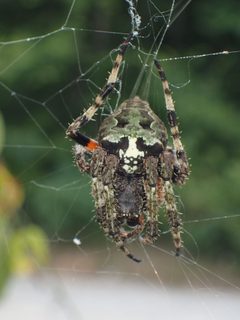
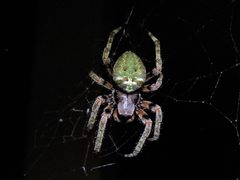
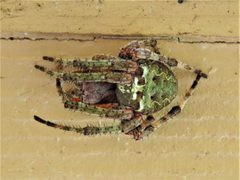
Araneus bicentenarius, commonly known as the giant lichen orbweaver, is a large orb-weaving spider in the Araneidae. It occurs in eastern North America, where it constructs notably large webs. Unlike most Araneus , typically position themselves at the edge of the web rather than hanging upside down in the center.
Pronunciation
How to pronounce Araneus bicentenarius: /aˈɾaneʊs bɪˌsɛntəˈneɪərɪəs/
These audio files are automatically generated. While they are not always 100% accurate, they are a good starting point.
Identification
Distinguished from other Araneus by its large size and distinctive behavioral trait of resting at the web edge rather than the hub. The specific epithet refers to the 1888 centennial of the U.S. Constitution. Lichen-like coloration provides camouflage against tree bark where webs are often constructed.
Images
Distribution
Eastern United States and southeastern Canada. Records include Vermont and other eastern states.
Behavior
Constructs large orb webs up to 8 feet in diameter. Unlike that typically hang upside down in the web center, this spends most of its time at the web edge. This positioning represents a notable behavioral divergence within the .
Similar Taxa
- Araneus marmoreusBoth are large, colorful Araneus orbweavers with variable patterning, but A. marmoreus typically rests in the web center and shows more extreme color .
- Araneus diadematusSimilar orb-weaving and , but A. diadematus is smaller, has a characteristic cross-shaped abdominal pattern, and occupies the web center.
More Details
Etymology
The specific epithet 'bicentenarius' commemorates the bicentennial of the United States Constitution in 1888, the year the was described by McCook.
Sources and further reading
- BugGuide
- Wikipedia
- GBIF taxonomy match
- iNaturalist taxon
- NCBI Taxonomy
- Catalogue of Life
- Arachnida | Beetles In The Bush | Page 5
- Bug Eric: Spider Sunday: Butterfly Orbweaver
- Answer to Super Crop Challenge #2 | Beetles In The Bush
- Do Chestnut, Lemon, or Peppermint Scents Repel Spiders?
- Bug Eric: Spider Season
- new spider | Blog