
Aculepeira
Chamberlin & Ivie, 1942
Species Guides
2- Aculepeira carbonarioides(Rock Orbweaver)
- Aculepeira packardi(Northern Orbweaver)
Aculepeira is a of orb-weaver spiders in the Araneidae, containing 26 and two as of January 2026. The genus was established by Chamberlin and Ivie in 1942. North American species are primarily associated with high elevation and high latitude , ranging from Alaska and the Yukon Territory to northern Mexico. Members of this genus construct typical orb webs and have been documented consuming pollen in addition to insect prey.
Pronunciation
How to pronounce Aculepeira: /ˌæk.jʊl.ɛˈpaɪ.rə/
These audio files are automatically generated. While they are not always 100% accurate, they are a good starting point.
Identification
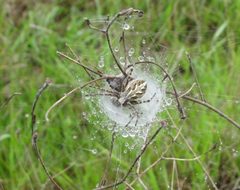
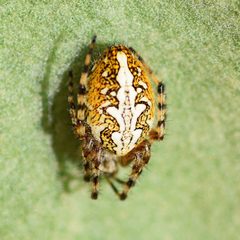
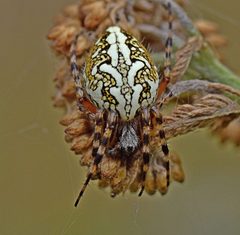
Aculepeira can be distinguished from similar orb-weavers such as Neoscona by examining abdominal markings, which differ markedly between the . Mature females average nearly 11 mm in body length, with males approximately 6 mm. Species-level identification requires microscopic examination of genitalia. The pattern may superficially resemble that of Neoscona oaxacensis, but careful inspection of ventral markings is necessary for correct assignment.
Images
Habitat
High elevation and high latitude . In North America, found in mixed conifer and aspen forests at elevations around 8,500 feet, as well as open meadows where webs are constructed between low-growing shrubs.
Distribution
Holarctic distribution. North American range from Alaska and the Yukon Territory to Labrador, and south to Chihuahua, Mexico and Pennsylvania, with additional records in the northeastern United States. Aculepeira packardi extends into the Russian Far East, Siberia, and northern China. An undescribed prairie species has been recorded in western Washington state. GBIF records indicate presence in Denmark, Norway, and Sweden.
Diet
Has been observed feeding on both insect prey and pollen. Research on Aculepeira ceropegia demonstrated that approximately 25% of food intake can consist of pollen, with the remainder being flying insects. Spiders actively consume pollen grains through extraoral digestion rather than accidental ingestion during web recycling.
Behavior
females typically occupy a silken retreat on the periphery of the web during daylight hours, occupying the web hub primarily during cool, overcast conditions. Webs are wheel-shaped orb webs constructed between vegetation. Spiders regularly consume their webs to recycle silk proteins.
Similar Taxa
- Neoscona oaxacensisSimilar patterning can cause misidentification; differs in abdominal markings and requires microscopic examination of genitalia for definitive separation.
More Details
Pollen consumption
Research by Dirk Sanders and Benjamin demonstrated that Aculepeira ceropegia actively selects pollen as food even when insect prey is available, challenging the classification of orb-weaver spiders as pure . Pollen grains are too large to pass through the spider's pharynx accidentally and must be actively consumed through extraoral digestion.
Species diversity
As of January 2026, the includes 26 and two . North American representatives include A. packardi, A. carbonarioides, and A. aculifera, with A. aculifera ranging as far south as Guatemala.
Sources and further reading
- BugGuide
- Wikipedia
- GBIF taxonomy match
- iNaturalist taxon
- NCBI Taxonomy
- Catalogue of Life
- Bug Eric: Aculepeira Orb Weavers
- Aculepeira_ceropegia_wp - Entomology Today
- Aculepeira ceropegia Archives - Entomology Today
- Orb-weaving Spiders use Webs to Trap Pollen in Addition to Insects
- Three new species of the orb-weaving spider genus Alpaida O. Pickard-Cambridge, 1889, the real male of A. guimaraes Levi, 1988 and the male of Aculepeira apa Levi, 1991 (Araneae: Araneidae)