
Wulfila tantillus
Chickering, 1940
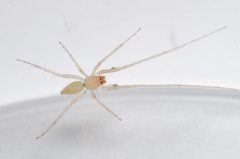
Wulfila tantillus is a of ghost spider in the Anyphaenidae, first described by Chickering in 1940. It belongs to a guild of active hunting spiders that do not construct webs for prey capture. The Wulfila is part of a family commonly referred to as ghost spiders due to their pale coloration and habits. Observations of Wulfila spiders have been documented in association with urban tree infested with scale insects, where they contribute to .
Pronunciation
How to pronounce Wulfila tantillus: /ˈwʌlfɪlə tænˈtɪləs/
These audio files are automatically generated. While they are not always 100% accurate, they are a good starting point.
Identification
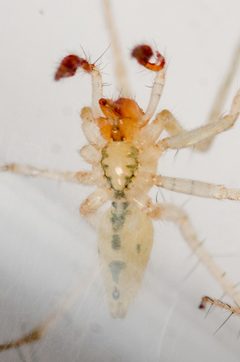
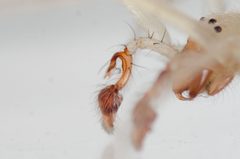
Wulfila tantillus can be distinguished from web-building spiders by its lack of web construction for prey capture. As a member of the Anyphaenidae , it likely exhibits the pale, somewhat translucent coloration typical of ghost spiders. -level identification requires examination of genitalic structures and other microscopic features; the specific epithet 'tantillus' (Latin for 'so small') suggests diminutive size. Differentiation from other Wulfila species and anyphaenid requires taxonomic knowledge.
Images
Habitat
Distribution
Panama; United States. GBIF records indicate distribution from USA to Panama, with specific locality records from Panama.
Behavior
Active hunting spider that does not construct webs for prey capture. Documented as part of the hunting spider guild in urban tree studies, where spiders in this were observed moving between tree canopies and understory shrubs.
Ecological Role
in urban . Observations of Wulfila spiders in -infested urban trees suggest they may contribute to predator that respond to scale insect . The presence of active hunting spiders like Wulfila in urban tree has been associated with enhanced prey removal in nearby shrubs, indicating potential for services in urban landscapes.
Human Relevance
Similar Taxa
- Other Anyphaenidae (ghost spiders)Share -level characteristics including pale coloration, activity, and similar body plan; require genitalic examination for -level separation.
- Other active hunting spiders (e.g., Oxyopidae, Salticidae, Clubionidae)Share the active hunting guild characteristic of not constructing capture webs, but differ in -level morphological features such as arrangement, structure, and cheliceral .
- Wulfila other species share -level characteristics; boundaries in Wulfila are narrow and require detailed taxonomic examination.
More Details
Taxonomic note
The specific epithet 'tantillus' is Latin for 'so small' or 'very little', presumably referring to the small body size of this relative to .
Urban ecology context
Wulfila spiders were specifically mentioned in research on -infested urban trees at North Carolina State University, where they were photographed by Matt Bertone as representatives of the active hunting spider guild. This research documented that scale-infested urban trees support higher abundance of active hunting spiders compared to uninfested trees.