
Anapidae
Simon, 1895
Ground Orb-web Spiders
Genus Guides
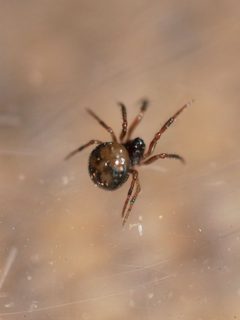
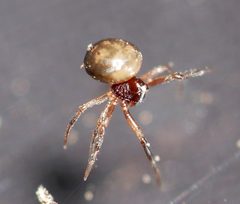
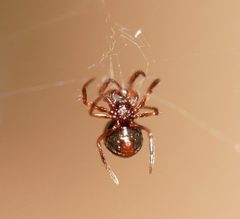
1Anapidae is a of minute spiders containing approximately 233 extant in 59 , with most measuring less than 2 mm in body length. The family has undergone significant taxonomic revision, incorporating the former families Micropholcommatidae and Holarchaeidae as . Members are primarily ground-dwelling inhabitants of moist forest , where many species construct diminutive orb webs less than 3 cm in diameter. The group exhibits remarkable anatomical conservation despite extreme miniaturization, retaining complete organ systems and musculature that comparable-sized insects often reduce or lose.
Pronunciation
How to pronounce Anapidae: //ænəˈpaɪdiː//
These audio files are automatically generated. While they are not always 100% accurate, they are a good starting point.
Identification
Anapids are distinguished from other small araneoid by a combination of minute size (typically <2 mm), absence of a cribellum, and presence of a labial spur visible between spread . number is variable and diagnostically useful: most possess six or eight eyes, but some have zero eyes (e.g., the subterranean *Epigastrina typhlops*) and others show reduced or absent rear eyes. The may be modified to elevate the eyes above the usual position. Chelicerae generally bear teeth on both margins, though *Acrobleps hygrophilus* uniquely lacks retromarginal teeth. Legs are short and typically spineless, though some (*Teutoniella*, *Borneanapis*) show reduced or modified spination. Female are reduced to coxal stumps in some species such as *Pseudanapis parocula*.
Images
Habitat
Moist ground-level in forested environments, particularly leaf litter and moss layers of rainforest floors. Some occupy hygrophilous (moisture-loving) microhabitats near water sources such as waterfalls. Elevation records span 595–1314 m in mountainous regions of Asia.
Distribution
Pantropical and southern temperate distribution with concentration in South America, Africa, Asia, Australia, and New Zealand. Sparse representation in northern temperate zones: Europe contains only *Comaroma simoni* and three *Zangherella* ; North America is limited to *Gertschanapis shantzi* and *Comaroma mendocino* in the United States. Asian records include China (Tibet, Yunnan, Hainan, Hunan, Jiangxi, Fujian), Laos, and Vietnam.
Behavior
Many construct small orb webs with diameters less than 3 cm. Web architecture shows evolutionary reduction or complete loss in some lineages (e.g., *Acrobleps*), representing derived conditions rather than retention of ancestral states. The identical bi-dimensional webs of *Elanapis* and symphytognathid spiders have evolved independently. One species, *Sofanapis antillanca*, has been documented as a kleptoparasite of austrochiline spiders.
Similar Taxa
- MysmenidaeFormerly included *Acrobleps* due to superficial morphological similarities; distinguished by absence of diagnostic anapid features including typical labral spur structure and specific modifications
- Symphytognathidae of bi-dimensional orb webs and similar minute size; web architecture evolved independently and differs in detailed construction; symphytognathids lack the labial spur characteristic of anapids
- Micropholcommatidae (as subfamily Micropholcommatinae)Now synonymized within Anapidae; previously recognized as distinct but molecular and morphological data support placement
Sources and further reading
- BugGuide
- Wikipedia
- GBIF taxonomy match
- iNaturalist taxon
- NCBI Taxonomy
- Catalogue of Life
- A review of the spider genus Sinanapis, with the description of a new species from Tibet (Araneae, Anapidae)
- Phylogenetic placement of the Tasmanian spider Acrobleps hygrophilus (Araneae, Anapidae) with comments on the evolution of the capture web in Araneoidea
- Miniaturization does not change conserved spider anatomy, a case study on spider Rayforstia (Araneae: Anapidae).