
Mysmenidae
Petrunkevitch, 1928
dwarf cobweb weavers
Genus Guides
2- Microdipoena(dwarf cobweb weaver spiders)
- Trogloneta(spurred orb-weavers)
Mysmenidae is a of minute spiders comprising approximately 135-188 described across 13-17 . Members are among the smallest known spiders, ranging from 0.75 to 3 mm in body length. The family is one of the least studied groups of orb-weaving spiders due to their diminutive size and cryptic habits. Many species exhibit kleptoparasitic , inhabiting the webs of other spiders to steal prey.
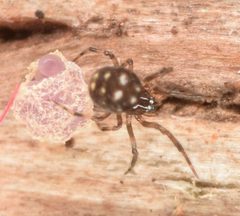
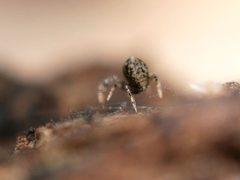
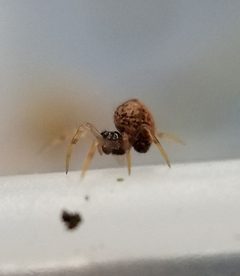
Pronunciation
How to pronounce Mysmenidae: //mɪsˈmɛnɪdiː//
These audio files are automatically generated. While they are not always 100% accurate, they are a good starting point.
Identification
Distinguished by extremely small body size (typically under 3 mm), eight , and disproportionately large spherical . The combination of minute size, cryptic coloration, and preference for humid microhabitats makes field identification challenging. -level identification requires examination of genitalia and other microscopic morphological features.
Images
Habitat
Humid microhabitats including moist leaf litter, moss, and caves. Some inhabit the webs of other spiders as kleptoparasites.
Distribution
Pantropical and subtropical distribution with records from the Americas, Africa, Asia, Europe, New Guinea, and various islands. Documented from Ecuador, China (Sichuan, Chongqing, Gaoligong Mountains), Jamaica, and other regions.
Behavior
Kleptoparasitism has been documented in the Isela and Mysmenopsis, where inhabit webs of spiders (primarily Dipluridae, specifically Linothele, and Lycosidae, specifically Aglaoctenus) to steal captured prey. Cocoon handling and dragline production have been observed in Trogloneta granulum.
Sources and further reading
- BugGuide
- Wikipedia
- GBIF taxonomy match
- iNaturalist taxon
- NCBI Taxonomy
- Catalogue of Life
- Pensoft Editorial Team | Blog - Part 141
- Uncategorized | Blog - Part 36
- 2 miniature spider species discovered in Giant Panda Sanctuaries of China | Blog
- Spinning activity of the spider Trogloneta granulum (Araneae, Mysmenidae): web, cocoon, cocoon handling behaviour, draglines and attachment discs
- Megadiverse Ecuador: a review of Mysmenopsis (Araneae, Mysmenidae) of Ecuador, with the description of twenty-one new kleptoparasitic spider species
- Descriptions of four kleptoparasitic spiders of the genus Mysmenopsis (Araneae, Mysmenidae) and their potential host spider species in the genus Linothele (Araneae, Dipluridae) from Ecuador
- Phylogenetic placement of eight poorly known spiders of Microdipoena (Araneae, Mysmenidae), with descriptions of five new species.
- Regression of East Tethys resulted in a center of biodiversity: A study of Mysmenidae spiders from the Gaoligong Mountains, China.