
Microdipoena
Banks, 1895
dwarf cobweb weaver spiders
Species Guides
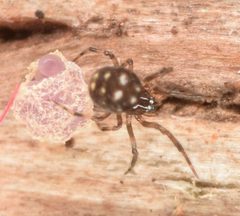
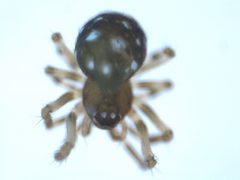
1Microdipoena is a of minute cobweb-weaving spiders in the Mysmenidae. First described by Nathan Banks in 1895, it contains 21 as of 2025. The genus has a nearly worldwide distribution, being absent only from Antarctica. Members are among the smallest spiders, typically inhabiting leaf litter and ground-level vegetation.
Pronunciation
How to pronounce Microdipoena: /ˌmaɪkroʊdɪˈpiːnə/
These audio files are automatically generated. While they are not always 100% accurate, they are a good starting point.
Identification
Microdipoena are distinguished from other Mysmenidae by their extremely small body size (among the smallest spiders known) and specialized genitalic structures. The can be separated from the closely related Isela by subtle differences in arrangement and male . Species-level identification requires examination of reproductive structures under microscopy.
Images
Habitat
Leaf litter in forested and woodland environments. Specimens have been collected from ground-level microhabitats including decomposing vegetation and soil surface layers.
Distribution
distribution spanning Eurasia, Africa, the Americas, and Oceanic/Pacific islands. Documented from China, Laos, Indonesia, Georgia, and Seychelles. Absent from Antarctica.
Similar Taxa
- IselaAnother in Mysmenidae; distinguished by differences in arrangement and male
- MysmenaLarger in same ; Microdipoena are generally smaller with distinct genitalic structures
More Details
Taxonomic history
The was established by Nathan Banks in 1895. A 2023 phylogenetic study confirmed its monophyly using molecular data from five gene fragments (16S, 18S, 28S, COI, H3) and described five new from China and Laos, representing the first records of Mysmenidae from Laos and Georgia.
Size
Members of this are among the smallest spiders known, though specific body size measurements are not consistently reported across descriptions.