
Macrochelidae
Genus Guides
2Macrochelidae is a of predatory mites in the order Mesostigmata. The family is primarily associated with ephemeral, nutrient-rich such as animal , where they prey on , oligochaete worms, and . on flying insects—particularly dung beetles and flies—enables between temporary resource patches. Some have been developed as agents for pest management.
Pronunciation
How to pronounce Macrochelidae: /ˌmækroʊˈkiːlɪdiː/
These audio files are automatically generated. While they are not always 100% accurate, they are a good starting point.
Identification
Macrochelidae can be distinguished from other Mesostigmata by the combination of an undivided shield with at least 28 setae pairs, genital shield with accessory , and the characteristic peritreme looped around the stigma. The presence of an arthrodial brush on the movable cheliceral digit is a key diagnostic feature. Males are identified by their shield configuration (holoventral or divided).
Images
Appearance
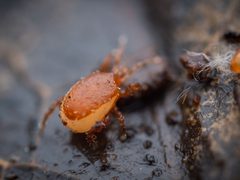
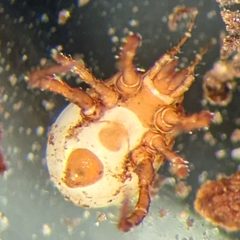
females possess an undivided shield bearing at least 28 pairs of setae. The sternal shield carries three pairs of setae; the genital shield bears one pair of setae with conspicuous accessory beneath the lateral margins. The ventrianal shield typically has 1–5 pairs of setae in addition to circumanal setae. The peritreme is usually looped around the stigma. The movable cheliceral digit usually has a well-developed arthrodial brush at its base. Adult males are similar but exhibit either a holoventral shield or separate sternigenital and ventrianal shields.
Habitat
Primary are ephemeral, organic-rich substrates: animal (coprophilous lifestyle), forest litter, decaying plant debris, beach wrack, and animal nests. Dung deposits represent the most extensively documented habitat, offering high prey and shelter but requiring mechanisms due to their temporary nature.
Distribution
. Documented from all major biogeographic regions including North America, Europe, South America (Colombia, Brazil), Southeast Asia (Indonesia: Bali, Sumatra, West Java, West Papua), and Australia.
Diet
Predatory. Prey includes oligochaete worms, , , and arthropod larvae. Most are within their patches.
Host Associations
- scarab beetles (Scarabaeidae) - Primary phoretic for to fresh deposits
- flies (Diptera) - /Includes Musca vetustissima and Stomoxys calcitrans; some facultatively parasitic
- burying beetles (Silphidae, Nicrophorus) - Documented association in North America
- longhorned beetles (Cerambycidae) - Observed in phoretic association, though less commonly documented than dung beetles
Life Cycle
Development includes , larva, , deutonymph, and stages. Phoretic is typically performed by adult females, though males and nymphs may also engage in this . Some exhibit thelytoky (production of female offspring from unfertilized eggs) or (production of male offspring from unfertilized eggs) in addition to .
Behavior
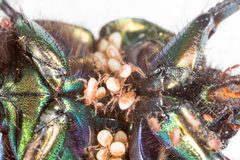
is the defining behavioral : mites actively seek, attach to, and ride on insects to disperse from depleted resources to new patches. Attachment triggers include chemical and behavioral cues specific to host . During phoresy, mites cease feeding and development. females are the primary stage. Phoretic specificity varies phylogenetically, with terminal showing stronger host commitment than early-derivative lineages.
Ecological Role
that regulate of and other microinvertebrates in and decaying organic matter. Contribute to nutrient cycling in ephemeral . Serve as prey for larger arthropods within the same microhabitats.
Human Relevance
agents: Macrocheles robustulus is commercially available for management of pest insects including flies and . Macrocheles muscaedomesticae has been investigated for control of flies. Forensic relevance: some associated with human corpses in Europe, indicating potential utility in forensic acarology.
Similar Taxa
- ParasitidaeAlso predatory mesostigmatic mites associated with ephemeral ; distinguished by divided shield and different setal counts
- LaelapidaeShare order Mesostigmata and some overlap; distinguished by genital shield and lack of arthrodial brush on
More Details
Phoresy definition and debate
The phoretic relationship of Macrochelidae has been central to defining itself. Farish and Axtell (1971) used Macrocheles muscaedomesticae to redefine phoresy as temporary attachment with cessation of feeding and ontogenesis for purposes. Alternative hypotheses (accidental boarding, obligate , phagophily) have been proposed for some associations but are not supported for the majority of macrochelid- relationships.
Reproductive plasticity
The exhibits multiple reproductive modes: , thelytoky (Geholaspis, Macrocheles), and (Glyptholaspis, Holostaspella, Macrocheles). This flexibility may facilitate of ephemeral by single females.
Sources and further reading
- BugGuide
- Wikipedia
- GBIF taxonomy match
- iNaturalist taxon
- NCBI Taxonomy
- Catalogue of Life
- Hitchin’ A Ride | Beetles In The Bush
- Biology of Macrocheles merdarius (Berlese) (Acari: Mesostigmata: Macrochelidae)
- Mites of the Macrocheles-Glaber Group in Australia (Acarina, Macrochelidae)
- Review Reflections on the biology, morphology and ecology of the Macrochelidae
- Macrocheles species (Acari: Macrochelidae) associated with human corpses in Europe
- Reflections on the biology, morphology and ecology of the Macrochelidae
- Macrocheles muscaedomesticae (Acari: Macrochelidae) asociados a Stomoxys calcitrans (Diptera: Muscidae) en el municipio de Sabanalarga, Antioquia Macrocheles muscaedomesticae (Acari: Macrochelidae) associated with Stomoxys calcitrans (Diptera: Muscidae) in the municipality of Sabanalarga, Antioquia
- New Macrocheles species (Acari, Mesostigmata, Macrochelidae) associated with burying beetles (Silphidae, Nicrophorus) in North America
- NOTES ON MACROCHELES (ACARI: MACROCHELIDAE) ASSOCIATED WITH SCARABAEID DUNG BEETLE IN RAJA AMPAT, WAIGEO ISLAND, WEST PAPUA, INDONESIA
- Macrochelid Mites(Acari: Macrochelidae: Macrocheles, Holostaspella) Associated with Scarabaeid Beetles in Sumatra, Indonesia.
- Macrochelid Mites (Arachnida : Acari : Macrochelidae : Glyptholaspis, Macrocheles, Neopodocinum) Associated with Dung Beetles in Bali, Indonesia
- Mites of the Macrochelid Genus Neopodocinum (Arachnida : Acari : Gamasida : Macrochelidae) Associated with Dung Beetles in West Java, Indonesia
- The mite Machrocheles robustulus (Mesostigmata, Macrochelidae) a new promising natural enemy of Haemonchus contortus (Strongylida, Trichostrongylidae).