
Penthaleus
C. L. Koch, 1835
earth mites
Species Guides
1- Penthaleus major(Blue Oat Mite)
Penthaleus is a of earth mites in the Penthaleidae, established by Carl Ludwig Koch in 1835. The genus contains 13 described distributed across every continent except Antarctica. Members are significant agricultural pests, particularly in southern Australia where they damage winter crops and pastures. The genus includes the (P. major), a notable pest of small grains.
Pronunciation
How to pronounce Penthaleus: //pɛnˈθeɪlius//
These audio files are automatically generated. While they are not always 100% accurate, they are a good starting point.
Identification
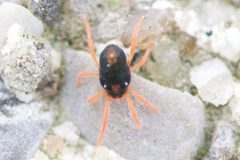
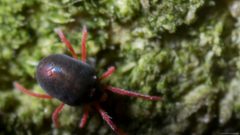
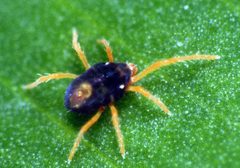
Distinguished from other prostigmatan mites by the combination of dark body coloration with distinctly reddish-orange legs. The (Penthaleus major) can be identified by its feeding habit and association with characteristic leaf-tip browning on small grains. Differentiation from the smaller brown wheat mite (Petrobia latens) is based on size, leg coloration, and preference—Penthaleus are more active in cooler, wetter conditions.
Images
Appearance
Small mites ranging from approximately 1/32 to 1/16 inch (0.8–1.6 mm) in length. Body dark brown to black. possess four pairs of reddish-orange legs. The body form is compact and typical of prostigmatan mites.
Habitat
Found in agricultural fields, pastures, and grassland . In southern Australia, they are particularly associated with crop and pasture systems. occur in temperate regions across multiple continents. Activity is concentrated in winter and early spring, with reduced activity during hot, dry periods.
Distribution
distribution excluding Antarctica. Documented from Australia (New South Wales), China, Europe (England, France, Germany, Italy, Norway, Spain, Sweden, Switzerland), Iran, Japan, Mexico, and the United States. The shows broad latitudinal range with adapted to temperate conditions.
Seasonality
Peak activity occurs during winter and early spring. decline during hot, dry summer conditions. In southern Australia, they represent a major winter pest. Feeding occurs primarily at night, with mites remaining near the base of plants during daylight hours.
Diet
Herbivorous. Feeds on leaves of small grains including wheat, barley, and oats, as well as various pasture grasses. Feeding damage appears as brown leaf tips and silvery-gray plant appearance.
Host Associations
- Triticum aestivum - feeds onwheat
- Hordeum vulgare - feeds onbarley
- Avena sativa - feeds onoats
Life Cycle
Specific details of stages are not well documented in available sources. Development likely includes , larval, and stages typical of Prostigmata. The (P. major) shows peaks in winter and early spring, suggesting seasonal patterns tied to temperature and moisture availability.
Behavior
feeding pattern. During daylight hours, mites remain inactive around the base of plants. Activity decreases significantly under hot, dry conditions. are more persistent in fields with continuous small grain .
Ecological Role
Herbivorous pest in agricultural . can cause significant damage to winter crops and pastures, reducing plant vigor and yield. Serves as prey for in agricultural systems, though specific predator relationships are not well documented.
Human Relevance
Major agricultural pest in southern Australia, causing economic damage to winter crops and pastures. The (Penthaleus major) is specifically noted as a pest of small grains in North America. Damage include leaf-tip browning, stunting, and silvery-gray plant appearance. Crop with non- plants is recommended for management.
Similar Taxa
- Petrobia latensBrown wheat mite—distinguished by smaller size, metallic dark brown coloration without reddish-orange legs, and elongated front legs twice the length of other leg pairs; prefers hot, dry conditions opposite to Penthaleus
- Aceria tosichella—much smaller (approximately 0.25 mm), white, sausage-shaped, with only four small legs; primarily a virus rather than direct feeding pest
More Details
Taxonomic history
Authorship dates vary between sources: 1835 (Wikipedia, GBIF) and 1836 (Catalogue of Life). The comprises 13 described with varying geographic ranges from (e.g., P. falcatus in New South Wales) to (P. major).
Agricultural significance
In southern Australia, Penthaleus are described as 'major winter pests,' indicating substantial economic impact. Damage is most severe in fields with continuous small grain ; with other crops reduces severity.