
Penthaleidae
Oudemans, 1931
earth mites
Genus Guides
1- Penthaleus(earth mites)
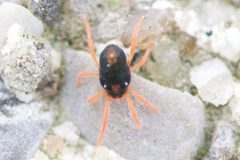
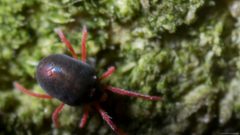
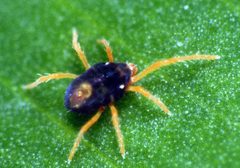
Penthaleidae, commonly known as earth mites, is a of mites in the order Trombidiformes. The family is distributed globally across every continent. In southern Australia, several are major agricultural pests, causing damage to winter crops and pastures. The family contains approximately 30 described species across seven , including economically significant species such as *Halotydeus destructor* (the redlegged earth mite) and *Penthaleus major* (the blue oat mite).
Pronunciation
How to pronounce Penthaleidae: /pɛnˈθæli.aɪdiː/
These audio files are automatically generated. While they are not always 100% accurate, they are a good starting point.
Identification
Earth mites are small, typically less than 2 mm in length. in this often exhibit bright coloration, with *Halotydeus destructor* showing distinctive red legs against a dark body, and *Penthaleus major* displaying a characteristic blue-green hue. They possess a rounded body shape and relatively long legs compared to body size. Microscopic examination is required for definitive identification to or species level, as external morphological differences can be subtle.
Images
Habitat
Terrestrial environments, primarily in soil surface layers and ground-level vegetation. Found in agricultural fields, pastures, and natural grasslands. In Australia, thrive in Mediterranean-type climates with cool, wet winters.
Distribution
distribution with records from Europe, Asia, Africa, North America, South America, Australia, and Antarctica (South Orkney Islands). Particularly abundant and economically significant in southern Australia including Western Australia, South Australia, New South Wales, and Victoria.
Seasonality
Peak activity occurs during winter months in southern Australia, with declining in hot, dry summer conditions. This winter-active pattern contrasts with many other mite pests and contributes to their agricultural impact on winter-growing crops.
Diet
Feed on plant material, including living plant tissue from seedlings, leaves, and stems of various crop and pasture .
Host Associations
- various crop plants - pestMajor winter pests of crops and pastures in southern Australia
- pasture grasses - pestSignificant damage to grazing pastures
Life Cycle
Has been observed to include , larval, and stages. Eggs are deposited in soil and can survive dry summer conditions, hatching with autumn rains. Multiple may occur during the winter growing season.
Behavior
Aggregates in large numbers on plants. activity pattern with feeding concentrated during daylight hours. Capable of rapid increase under favorable cool, moist conditions.
Ecological Role
Herbivores that can reach pest densities in agricultural systems. No known significant ecological role in natural has been documented.
Human Relevance
Major agricultural pests in southern Australian farming systems. *Halotydeus destructor* (redlegged earth mite) and *Penthaleus major* (blue oat mite) cause estimated millions of dollars in damage to cereals, legumes, canola, and pastures. Control relies heavily on chemical , with resistance development documented in some .
Similar Taxa
- TetranychidaeBoth are plant-feeding mite , but Tetranychidae (spider mites) are typically smaller, produce silk webbing, and are more active in warm seasons rather than winter
More Details
Agricultural impact
The 's economic significance is concentrated in Australian agriculture, despite the distribution. This reflects the combination of suitable climate, extensive winter cropping, and the presence of susceptible plants.
Taxonomic revision
The 's classification was substantially revised by Qin & Halliday in 1996, with many new described and several redefined.