
Aculops
Keifer, 1966
Species Guides
6- Aculops aenigma
- Aculops ailanthii(Ailanthus leafcurl mite)
- Aculops cannabicola(hemp russet mite)
- Aculops euphorbicolus
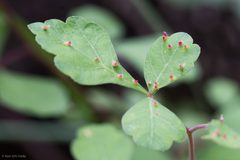
- Aculops rhois(Poison Ivy Gall Mite)
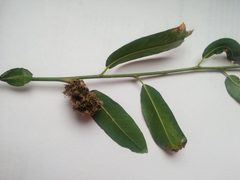
- Aculops tetanothrix(willow gall mite)
Aculops is a of eriophyid mites comprising parasitic plant-feeding . Several members are significant agricultural pests, including Aculops lycopersici (tomato russet mite) and Aculops cannabicola (hemp russet mite). The genus also includes species under consideration for , such as Aculops ailanthii for management of tree-of-heaven (Ailanthus altissima). within Aculops remains incompletely documented, with new species continuing to be described.
Pronunciation
How to pronounce Aculops: //ˈæk.jə.lɒps//
These audio files are automatically generated. While they are not always 100% accurate, they are a good starting point.
Images
Habitat
Associated with aboveground plant tissues; occupy diverse plant environments including agricultural crops, ornamentals, and wild plants. Specific microhabitat preferences vary by species.
Distribution
distribution with records from Europe, Africa, Asia, Australasia, Pacific Islands, and North America. Distribution patterns reflect plant availability and human-mediated transport of agricultural pests.
Diet
Phytophagous; feed on epidermal of stems and leaves. Specific associations vary: A. lycopersici infests Solanaceae including tomato, potato, eggplant, and tobacco; A. cannabicola specializes on Cannabis sativa; A. fuchsiae occurs on Fuchsia species; A. ailanthii occurs on Ailanthus altissima.
Host Associations
- Solanum lycopersicum (tomato) - primary A. lycopersici
- Solanum tuberosum (potato) - A. lycopersici
- Solanum melongena (eggplant) - A. lycopersici
- Solanum nigrum (black nightshade) - alternative A. lycopersici; supports higher than tomato
- Nicotiana tabacum (tobacco) - A. lycopersici
- Capsicum annuum (bell pepper) - A. lycopersici
- Petunia hybrida (petunia) - A. lycopersici
- Ipomoea batatas (sweet potato) - A. lycopersici
- Convolvulus arvensis (field bindweed) - A. lycopersici
- Cannabis sativa (hemp) - primary A. cannabicola
- Fuchsia spp. - primary A. fuchsiae
- Ailanthus altissima (tree-of-heaven) - primary A. ailanthii
Ecological Role
Agricultural pests causing direct plant damage through epidermal feeding; some may serve as agents against plants. A. lycopersici can cause over 65% crop loss in tomatoes under heavy . Black nightshade acts as facilitating pest persistence between crop cycles.
Human Relevance
Economic impact through damage to tomato, hemp, and ornamental crops. A. lycopersici and A. cannabicola are managed through including chemical control and conservation of predatory mites. A. ailanthii is being evaluated as biocontrol agent for tree-of-heaven in North America.
Similar Taxa
- AceriaBoth are eriophyid with vagrant or gall-forming ; separation requires microscopic examination of morphological characters
- PhyllocoptrutaOverlapping associations on citrus; Aculops pelekassi was formerly classified as Phyllocoptruta pelekassi
More Details
Taxonomic Status
The remains taxonomically active with new descriptions continuing, particularly from under-surveyed regions such as New Zealand.
Research Gaps
Basic is unknown for most ; research has concentrated on economically significant pests, leaving the majority of the poorly characterized.
Sources and further reading
- BugGuide
- Wikipedia
- GBIF taxonomy match
- iNaturalist taxon
- NCBI Taxonomy
- Aculops cannibicola Archives - Entomology Today
- Aculops lycopersici Archives - Entomology Today
- IPM in Hemp: Managing Pests in a "New" Crop
- Rice Root Aphid: An Insect Surprise on Indoor-Grown Cannabis
- How to Enhance Communication and Make Your Research More Accessible
- How One Entomologist Became a Detective of 'Pest Mysteries'
- Aculops fuchsiae . [Distribution map].
- Aculops lycopersici . [Distribution map].
- The role of black nightshade in population development of tomato russet mite (Aculops lycopersici)
- Detección de la presencia del ácaro (Aculops lycopersici) causante del bronceamiento del tomate (Lycoprsicon esculentum) en El Salvador, América Central
- Potential of two omnivorous iolinid mites as predators of the tomato russet mite, Aculops lycopersici
- What Could Arrest an Eriophyoid Mite on a Plant? The Case of Aculops allotrichus from the Black Locust Tree
- Citrus Pest Quick Guide: Citrus Rust Mite and Pink Citrus Rust Mite (Phyllocoptruta oleivora Ashmead) (Aculops pelekassi Keifer)
- Laboratory evaluation of Beauveria bassiana strain ATCC74040 as a potential biocontrol agent of Aculops lycopersici.
- Lethal and Sublethal Effects of Carlina Oxide and Acmella oleracea Extract Enriched in N-Alkylamides on Aculops lycopersici (Acari: Eriophyidae) and Its Predator Typhlodromus exhilaratus (Acari: Phytoseiidae) in Laboratory Tests.