
Pterygosomatidae
scale mites
Genus Guides
1Pterygosomatidae is a of prostigmatic mites in the order Trombidiformes, commonly known as mites. These mites are obligate of lizards, primarily infesting the skin and scales of their reptilian . The family includes multiple , notably Pterygosoma, Geckobia, Geckobiella, Pimeliaphilus, and Neopterygosoma. within this family exhibit high host specificity, with particular mite lineages associated with specific lizard families including Agamidae, Gekkonidae, Liolaemidae, and Gerrhosauridae.
Pronunciation
How to pronounce Pterygosomatidae: //ˌtɛrɪɡoʊˈsoʊmətəˌdiː//
These audio files are automatically generated. While they are not always 100% accurate, they are a good starting point.
Identification
Identification to requires examination of association and specific morphological characters. Pterygosoma are associated with agamid lizards and possess characteristic setal arrangements including antero-dorsal, dorso-, and postero-lateral setae. Geckobia species infest geckos and can be distinguished by shape and number of dorsal setae. Geckobiella occurs on tropidurid and iguanid lizards, distributed under host . Pimeliaphilus has been recorded from multiple lizard . Neopterygosoma is restricted to South American liolaemid lizards. Species-level identification requires detailed examination of leg chaetotaxy (particularly genua IV and IV), number and shape of genital setae, dorsomedial and ventromedial setae counts, and subcapitular setae presence. Microscopic examination of slide-mounted specimens is essential; scanning electron microscopy may be required for subtle characters.
Images
Appearance
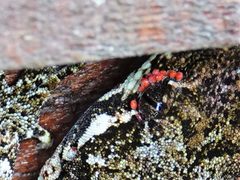
mites are dorsoventrally flattened mites adapted for life beneath reptilian scales. The idiosoma is typically broad and often covered by a or sclerotized plates. Key morphological features include: and idiosomal setae arranged in distinct patterns; legs with characteristic chaetotaxy including specific setae on genua and ; palps with setae dG and dF; and in some , a prodorsal shield represented by an unstriated area of idiosomal . occurs in , with females generally larger than males. Larvae may also exhibit sex-specific in some , differing in idiosoma shape, size, and genital area position. The body is typically small, ranging from approximately 200–800 micrometers depending on species and life stage.
Habitat
Pterygosomatidae mites inhabit the of lizards, specifically occupying spaces beneath and within skin folds. Microhabitat preferences vary by : Geckobia favor skin folds, which provide protection and concealment; Pterygosoma species occur on agamid lizard scales, with some species restricted to of flying dragons (Draco); Geckobiella sp. distributes uniformly under scales across the 's entire body. Mite-pockets (specialized scale recesses) serve as sites for some species. The mites are permanent , completing their entire on the host body.
Distribution
The has global distribution coinciding with lizard ranges. Pterygosoma occur in Africa, Asia, and the Arabian Peninsula, with biogeographic origins in North Africa and of Asia via the Arabian Peninsula. Geckobia species are , with records from Indonesia, Timor-Leste, Peru, Crimea, Malta, and Brazil. Neopterygosoma is restricted to South America (Argentina). Geckobiella has been recorded in Brazil and Panama. Specific distribution records include: Egypt and Sudan for Pterygosoma aegyptiaca; 25 sites across Indonesia for Geckobia species; Chapada do Araripe, Ceará State, Brazil for Geckobiella sp.; subtropical Andean Pacific region of Peru for Geckobia andina and G. circumdata; Crimea for G. sharygini; and Malta for G. estherae.
Seasonality
levels of Geckobia sharygini on Mediodactylus kotschyi show slight increase from spring to autumn, with newborn lizards exhibiting lower infestation rates. Otherwise, specific seasonal patterns are not well documented for most ; as permanent , they are present year-round on .
Host Associations
- Agamidae (agamid lizards, including agamas and spiny-tailed lizards) - obligate Primary for Pterygosoma; includes Pseudotrapelus, Acanthocercus, Uromastyx
- Gekkonidae (geckos) - obligate for Geckobia; includes Hemidactylus, Cosymbotus, Hemiphyllodactylus, Phyllodactylus, Mediodactylus, Tarentola
- Liolaemidae (South American tree lizards/iguanas) - obligate for Neopterygosoma; includes Liolaemus robertmertensi
- Gerrhosauridae (African plated lizards) - obligate for Gerrhosaurobia (formerly subgenus of Pterygosoma)
- Tropiduridae (neotropical ground lizards) - obligate for Geckobiella; includes Tropidurus hispidus
- Iguanidae (iguanas) - obligate for Geckobiella; includes Iguana iguana
Life Cycle
The includes active stages (larva, , deutonymph, male and female) and quiescent stages (nymphochrysalis, deutochrysalis, imagochrysalis). In Neopterygosoma robertmertensi, all active stages except males were described, with detailed ontogenetic changes documented. Protonymphs have been described for Pterygosoma engai, P. indare, and P. longipalpae; deutonymphs for P. transvaalense. Larval sex-specific has been observed in some , with female larvae differing from male larvae in idiosoma shape, size, and genital area position—a feature reported for the first time in the . Development occurs entirely on the body.
Behavior
Pterygosomatidae mites are permanent that complete their entire on lizard . Multiple may coexist sympatrically on the same host individual or , as observed with three Geckobia species on Indonesian geckos. Mites exhibit site specificity: Geckobia occupies skin folds for protection; Geckobiella distributes uniformly under ; some Pterygosoma species restrict themselves to . Geckobiella stamii has been observed attached to Amblyomma dissimile ticks on Iguana iguana, suggesting possible phoretic or hyperparasitic , though the nature of this interaction remains uncertain. Mite occurs in protected microhabitats, with intensity varying by host species, body size, and skin —hosts with fewer skin folds show lower mite .
Ecological Role
As obligate , pterygosomatid mites form persistent associations with lizard . Their distribution and diversity patterns reflect host , with mite showing congruence with host phylogeny at the level. Coevolutionary analyses indicate host-switching events, such as the ancestral Pterygosoma lineage switching from plated lizards (Gerrhosauridae) to agamids (Agamidae). Mites may influence host through direct parasitic effects, though specific impacts on host health or are not well quantified. The presence of mite and forms on hosts (in the case of Geckobiella stamii) suggests complex interspecific interactions within the ectoparasite .
Human Relevance
Pterygosomatidae mites have no direct economic or medical importance to humans. They are of academic interest for studies of - , historical , and mite . The serves as a model for understanding the evolution of host specificity and the role of host-switching in parasite diversification. No reports indicate these mites parasitize humans or domestic animals.
Similar Taxa
- Trombiculidae (chiggers)Both are prostigmatic mites associated with reptile ; however, trombiculid larvae are transient that feed and drop off, whereas pterygosomatids are permanent . Trombiculids often aggregate in mite-pockets, while pterygosomatids occupy surfaces and skin folds.
- HirstiellidaeFormerly included some pterygosomatid ; distinguished by morphological characters of the idiosoma and leg chaetotaxy. Geckobiella diolii was transferred from Hirstiella to Geckobiella, reflecting taxonomic revisions based on morphological re-examination.
More Details
Taxonomic History
The has undergone substantial taxonomic revision. The Pterygosoma was found to be non-monophyletic, leading to elevation of subgenera to genus rank: Gerrhosaurobia became a full genus, and the ligare group was transferred to the new genus Neopterygosoma. Seven Pterygosoma were elevated to rank, and four species were synonymized in recent revisions.
Fossil Record
The first fossil pterygosomatid mite was reported from French Lower Cretaceous amber, representing the oldest known occurrence of the and providing minimum age estimates for the group.
Research Methods
Systematic studies rely heavily on morphological characters including leg chaetotaxy (- I–IV, I–IV), idiosomal setal patterns, and structure. Phylogenetic analyses use maximum with successive and implied weighting approaches. association data are critical for identification and biogeographic interpretation.
Sources and further reading
- BugGuide
- Wikipedia
- GBIF taxonomy match
- iNaturalist taxon
- NCBI Taxonomy
- Catalogue of Life
- Three Species of Ectoparasite Mites (Acari: Pterygosomatidae) Infested Geckos in Indonesia
- A redescription of Pterygosoma aegyptiaca Mostafa (Acari: Prostigmata: Pterygosomatidae), a little known ectoparasitic mite of spiny-tailed lizards (Squamata: Agamidae), with new morphological data for the Pterygosomatidae
- A systematic revision of the scale mite genus Pterygosoma Peters, 1849 (Acariformes: Pterygosomatidae)
- Systematics of reptile-associated scale mites of the genus Pterygosoma (Acariformes: Pterygosomatidae) derived from external morphology
- Life stages and phylogenetic position of the new scale-mite of the genus Neopterygosoma (Acariformes: Pterygosomatidae) from Robert's Tree Iguana
- New species and records of scale mites (Acari: Pterygosomatidae) from Arabian agamid lizards (Squamata: Agamidae)
- A New Species of Mites of the Genus Geckobia (Prostigmata, Pterygosomatidae), Parasitic on Mediodactylus Kotschyi (Reptilia, Gekkota) from Crimea
- Does the African native host explain the African origin of the parasite? The Maltese Geckobia estherae n. sp. parasitic on Tarentola mauritanica (Acari: Raphignathoidea: Pterygosomatidae)
- Redescription ofPterygosoma patagonica(Acariformes: Pterygosomatidae) with new host and distribution data
- A parasite without host: The first fossil pterygosomatid mite (Acari: Prostigmata: Pterygosomatidae) from French Lower Cretaceous amber
- New records of the mites Geckobia bataviensis Vitzthum, 1926 and Pterygosoma dracoensis Jack, 1962 (Trombidiformes: Pterygosomatidae) from Timor-Leste
- Two new species of the genus Geckobia Mégnin, 1878 (Acariformes, Prostigmata, Pterygosomatidae) from Peru
- Pterygosomatidae and Trombiculidae mites infesting Tropidurus hispidus (Spix, 1825) (Tropiduridae) lizards in northeastern Brazil
- Is Geckobiella stamii (Acari: Pterygosomatidae) a hyperparasite or phoretic on Amblyomma dissimile (Acari: Ixodidae) associated with Iguana iguana from Panama?
- Erratum: (Description of all active life stages (except male) of the Pimeliaphilus lindquisti sp. nov. (Acari: Prostigmata: Pterygosomatidae) with review of host specificity and world distribution of the genus)
- Life Stages and Phylogenetic Position of the New Scale-Mite of the Genus Neopterygosoma (Acariformes: Pterygosomatidae) from Robert's Tree Iguana.