
Silvanidae
W. Kirby, 1837
Silvan Flat Bark Beetles, Silvanid Flat Bark Beetles
Subfamily Guides
2- Brontinae
- Silvaninae(silvanid flat bark beetles)
is a of small beetles in the superfamily Cucujoidea, comprising approximately 68 and 500 described . Members are found on all continents except Antarctica, with highest diversity in the Old World tropics. The family is divided into two : Brontinae (larger, loosely jointed beetles with long and mandibular mycangia) and Silvaninae (smaller beetles with closed procoxal cavities). While many species inhabit subcortical environments under bark, several genera have become economically significant stored product pests.
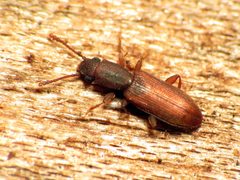
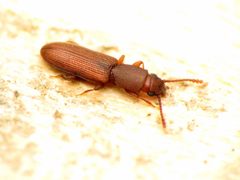
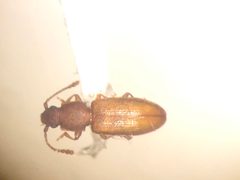
Pronunciation
How to pronounce Silvanidae: /sɪlˈvænɪˌdiː/
These audio files are automatically generated. While they are not always 100% accurate, they are a good starting point.
Images
Habitat
Most inhabit subcortical under dead bark, in leaf litter, or in soil. Members of Brontini are found under dead bark, with some occurring on exterior surfaces of dead wood in wet forests or under rocks in alpine areas. Telephanini typically occur on withered, pendant leaves of Musaceae and Heliconiaceae. Silvaninae occupy subcortical habitats, leaf litter, and soil. Some species are in nests or ant-plant petioles. Several pest species have adapted to stored product environments including grain facilities and households.
Distribution
All continents except Antarctica. Most diverse at generic and levels in the Old World tropics. Ten contain species with or near-cosmopolitan distributions due to human commerce, including Ahasverus, Oryzaephilus, Silvanus, Cryptamorpha, and Monanus.
Diet
Primarily fungivorous. Some feed on honeydew produced by mealybugs (Hemiptera: Pseudococcidae) in -plant associations. Stored product pest species feed on cereal grains, oatmeal, rolled oats, bran, brown rice, and oilseed products including nuts and shelled sunflower seeds.
Life Cycle
Development from to can occur in three to four weeks under optimal temperature and humidity conditions. Adult lifespan averages six to ten months, with some individuals living up to three years. Females deposit between 40 and 285 eggs in their lifetime.
Ecological Role
Decomposers in forest through and association with decaying wood and leaf litter. Some serve as in nests. Several species function as significant stored product pests in human food systems. The saw-toothed grain (Oryzaephilus surinamensis) serves as for the Cephalonomia tarsalis (Hymenoptera: Bethylidae), supporting research.
Human Relevance
Several contain economically important stored product pests. Oryzaephilus is the most significant, with O. surinamensis () and O. mercator (merchant grain ) being common pests of grains and cereal products. Other pests include Ahasverus advena, Cathartus quadricollis, and Nausibius clavicornis. These contaminate food products and reduce grain quality but do not pose direct health threats to humans. Management relies on proper storage in sealed containers.
Sources and further reading
- BugGuide
- Wikipedia
- GBIF taxonomy match
- iNaturalist taxon
- NCBI Taxonomy
- Catalogue of Life
- Bug Eric: Merchant Grain Beetle
- Bug Eric: January 2011
- Three new species and new records of African Psammoecus Latreille (Coleoptera, Silvanidae)
- Life table parameters of the parasitoid Cephalonomia tarsalis (Hymenoptera : Bethylidae) and its host the saw-toothed grain beetle Oryzaephilus surinamensis (Coleoptera : Silvanidae)