
Silvaninae
W. Kirby, 1837
silvanid flat bark beetles
Genus Guides
10- Ahasverus
- Airaphilus
- Cathartosilvanus
- Cathartus
- Monanus
- Nausibius
- Oryzaephilus(sawtoothed grain beetles)
- Pensus
- Silvanoprus
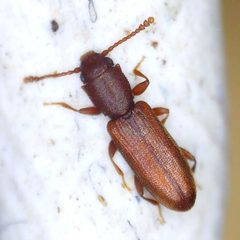
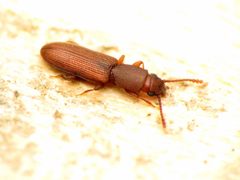
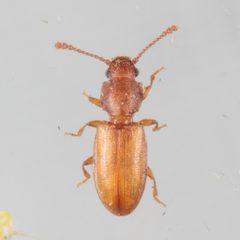
Silvaninae is a of silvanid flat bark beetles ( Silvanidae) comprising approximately 11 and at least 30 described . The subfamily includes several economically significant stored product pests, most notably species in the genera *Oryzaephilus* and *Cathartus*. Members are characterized by their dorsoventrally flattened bodies adapted for living under bark or in similar confined spaces. The group has a distribution with species found across multiple continents.
Pronunciation
How to pronounce Silvaninae: //ˌsɪlvəˈnaɪniː//
These audio files are automatically generated. While they are not always 100% accurate, they are a good starting point.
Identification
Distinguished from other silvanid by the combination of dorsoventral flattening, three-segmented antennal club, and five-segmented . The *Oryzaephilus* (sawtoothed grain beetle and merchant grain beetle) is recognized by the six sawtoothed projections on each side of the pronotum. *Cathartus* lack these pronounced teeth and have more rounded body contours. Separation from Cucujidae (cucujid bark beetles) requires examination of antennal structure and tarsal segmentation.
Images
Appearance
Body dorsoventrally flattened, elongated to oval in shape. with distinct three-segmented club. Pronotum with lateral margins often expanded or toothed. typically parallel-sided, completely covering the . with five segments on all legs. Body length generally 2–6 mm. Coloration variable, ranging from pale brown to dark brown or black.
Habitat
Primarily associated with dead or decaying wood, occurring under loose bark of trees and in fallen logs. Several have adapted to human-modified environments, inhabiting stored grain, dried fruit, and other food products. Forest span both temperate and tropical regions.
Distribution
distribution. Native ranges encompass North America, South America, Europe, Africa, Asia, and Australasia. Human-mediated has established several worldwide as stored product pests.
Diet
Many are mycophagous or saprophagous, feeding on fungal and decaying plant matter under bark. Several species in *Oryzaephilus*, *Cathartus*, and *Ahasverus* are significant pests of stored products, feeding on grain, cereals, dried fruit, nuts, and chocolate.
Life Cycle
Complete with , larval, pupal, and stages. Larvae are elongate, cylindrical, and mobile. Developmental rates vary by and temperature; stored product pests can complete multiple annually under favorable conditions. typically occurs in sheltered locations within the substrate.
Behavior
and larvae are agile and fast-moving. When disturbed, adults often adopt a death-feigning posture or seek tight crevices. Stored product demonstrate strong positive thigmotaxis, aggregating in cracks and corners of storage containers. Some species are capable of and are attracted to light.
Ecological Role
Decomposers in forest , contributing to nutrient cycling through consumption of fungi and decaying wood. In stored product environments, act as primary or secondary pests, facilitating spoilage and providing food for other pests.
Human Relevance
Several are major stored product pests causing significant economic losses. *Oryzaephilus surinamensis* (sawtoothed grain beetle) and *Oryzaephilus mercator* (merchant grain beetle) are among the most economically important pests of grain, cereals, and processed foods globally. *Cathartus quadricollis* (square-necked grain ) and *Ahasverus advena* (foreign grain beetle) are also significant pests. Control relies on , proper storage, and .
Similar Taxa
- BrontinaeOther of Silvanidae; distinguished by different antennal structure and less pronounced body flattening in many
- Cucujidae of flat bark beetles with similar flattened habitus; separated by antennal club segmentation and other mouthpart characters
More Details
Economic importance
The contains some of the most widespread and damaging stored product beetles. *Oryzaephilus* are particularly problematic due to their small size, allowing penetration of packaging, and their rapid rate.
Taxonomic history
Historically treated as a (Silvanidae) or as part of Cucujidae; current classification places Silvaninae as a within an expanded Silvanidae sensu lato.