
Nausibius clavicornis
(Kugelann, 1794)
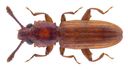
Nausibius clavicornis is a silvanid flat bark beetle known primarily as a pest of stored sugar products. It is frequently recorded from sugar commodities and has been most commonly collected from sugar in Trinidad, where it appears restricted to this substrate. Under laboratory conditions, development from to averages 30 days. The exhibits relatively high and adult longevity, with females living up to 163 days and producing an average of 275 eggs. However, it is unlikely to multiply rapidly in raw or unrefined sugar, and any deterioration it causes in stored products is minor compared to other factors.
Pronunciation
How to pronounce Nausibius clavicornis: /naʊˈsɪbiəs ˌklævɪˈkɔrnɪs/
These audio files are automatically generated. While they are not always 100% accurate, they are a good starting point.
Images
Habitat
Stored sugar products; specifically sugar commodities. In Trinidad, it has been recorded exclusively from sugar and not collected from any other source.
Distribution
. Recorded from Africa, Australia, the Caribbean Sea, Europe and Northern Asia (excluding China), Central America, North America, Oceania, South America, and Southern Asia. Specific distribution records include Flores and the Caribbean.
Diet
Sugar-based substrates. In laboratory studies, it has been reared on Haydak's formula and unrefined sugars including raw and yellow-crystal sugar.
Life Cycle
to development averages 30 days with five larval instars, or approximately 32 days with six instars, under controlled conditions (85°F, 75% RH). Egg incubation averages just under five days. Larvae typically undergo 5-6 moults; females more commonly have six instars, while males may complete development in five. Disturbance during larval development tends to increase instar number, with severe disturbance potentially inducing a seventh moult.
Behavior
Disturbance during larval development affects developmental trajectory, increasing the number of larval instars. When disturbed, both sexes tend toward six instars rather than five, and severe disturbance may induce a seventh moult.
Ecological Role
Minor pest of stored sugar products. Unlikely to multiply rapidly in raw or unrefined sugar. Direct deterioration of stored sugar attributable to this is probably small in comparison with that caused by other factors.
Human Relevance
Recognized as a stored product pest, particularly of sugar. However, its economic impact is limited due to reduced and high mortality on unrefined sugars, and its inability to multiply rapidly in typical storage conditions.