
Ahasverus advena
(Waltl, 1832)
Foreign grain beetle
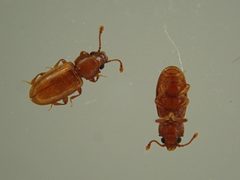
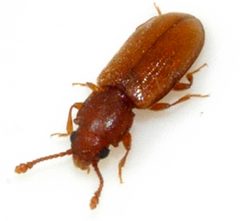
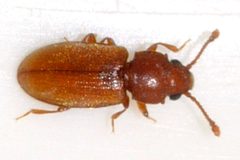
Ahasverus advena, commonly known as the foreign grain , is a small silvanid beetle approximately 2 mm in length with a reddish-brown to black coloration. It is a of American origin now reported from 110 countries, where it occurs in stored products facilities and diverse outdoor . The species is uniquely adapted to fungal feeding, with larvae capable of developing on fungi alone and elevated to aflatoxins compared to other stored product beetles. It serves as an indicator of damp, moldy conditions rather than a direct pest of grain, as it does not feed on intact grain kernels but rather on associated fungal growth.
Pronunciation
How to pronounce Ahasverus advena: //əˌhæsˈvɪərəs ædˈviːnə//
These audio files are automatically generated. While they are not always 100% accurate, they are a good starting point.
Identification
Distinguished from other grain beetles by the slight projections or knobs on each front corner of the pronotum and club-shaped . Most similar to in the Ahasverus; A. rectus in particular causes confusion in North American grain bins. Separation from A. rectus and other Ahasverus requires careful examination of subtle morphological characters.
Images
Appearance
are approximately 2 mm in length with a reddish-brown to sometimes black coloration. The pronotum bears slight projections or knobs on each front corner. are club-shaped. Larvae are worm-like, cream-colored, and reach approximately 3 mm in length before pupating into darker adults. Males and females are identical in appearance at both larval and adult stages.
Habitat
Grain storage and processing facilities including empty grain bins, wheat immediately after harvest, flour mills, feed mills, warehouses, railroad cars, and retail stores. Also found in wall voids, crawl spaces, and attics with fungal growth. Outdoor include compost heaps, haystacks, and manure heated by fermentation, which allow in cold climates. Ripening grain in fields and damp, moldy grain in temperate climates also support .
Distribution
distribution reported from 110 countries across tropical and temperate regions. Documented in North America, South America, Europe, Africa, Asia, and Oceania including specific records from Albania, Algeria, Argentina, Australia, Austria, Azerbaijan, Bangladesh, Belarus, Belgium, Benin, Bosnia Herzegovina, Brazil, Bulgaria, Burundi, Cameroon, Canada, Canary Islands, Chile, China, Colombia, Congo, Croatia, Cuba, Czech Republic, Denmark, Dominican Republic, Ecuador, England, Estonia, Ethiopia, Finland, France, French Guiana, Germany, Ghana, Greece, Grenada, Guadeloupe, Honduras, Hungary, India, Indonesia, Iran, Ireland, Israel, Italy, Ivory Coast, Jamaica, Japan, Kyrgyzstan, Latvia, Lesotho, Liberia, Libya, Liechtenstein, Lithuania, Luxemburg, Madeira, Malawi, Malaysia, Mexico, Micronesia, Monaco, Morocco, Montenegro, Mozambique, Netherlands, New Caledonia, New Zealand, Nigeria, Norway, Pakistan, Panama, Papua New Guinea, Paraguay, Philippines, Poland, Portugal, Puerto Rico, Romania, Russia, Rwanda, Samoa, Siberia, Singapore, Slovakia, Slovenia, Solomon Islands, South Africa, Spain, Sri Lanka, St Helena, St. Lucia, Suriname, Sweden, Switzerland, Taiwan, Thailand, Tonga, Trinidad and Tobago, Tunisia, Turkey, Uganda, Ukraine, United States, and Vietnam.
Seasonality
Most abundant early in wheat storage, with declining as grain dries. Seasonal peaks occur during wet seasons; absence in dry seasons. Can overwinter in compost heaps, haystacks, and manure heated by fermentation in cold climates.
Diet
Feeds primarily on fungi including yeasts and molds growing on substrates. Larvae can complete development on fungi alone. Found on moldy grain, peanuts, dried fruits, and various moist locations where fungi develop. Has been observed to exhibit predatory on some commodities, though extent is unclear.
Life Cycle
females begin laying 3 to 4 days after emerging from pupa, producing 1 to 4 eggs per day with maximum of 8 to 12. Eggs laid singly or in clusters of two to three, hatching in 4 to 5 days. Larval stage completed in 11 to 19 days, with taking 3 to 5 days. Larval development takes longer in drier conditions. Mated males live approximately 159 days; mated females approximately 208 days. Unmated beetles live longer, with males up to 275 days and females up to 300 days. Egg-to-adult development requires 15 to 62 days on suitable fungi; larvae fail to develop to adults at 58% relative humidity.
Behavior
Strong fliers capable of locating moldy grain from considerable distance. Attracted to fungal odors including 3-octanol and other fungal volatiles, as well as high moisture commodities. Capable of disseminating grain fungi, causing hot spots within grain mass. Migrates to artificially created hot spots in grain. concentrate along bin walls where moisture content is highest. Rapid population decline occurs when dries. Females preferentially oviposit on fungal supporting most successful offspring development.
Ecological Role
for poor storage conditions and damp, moldy commodities. Disseminates grain fungi causing hot spots within stored grain. Potential role in as a , though this remains speculative. Associates with fungal in decomposing organic matter.
Human Relevance
Not a direct pest of stored products as it does not feed on intact grain or damage food structures. Presence indicates damp storage conditions and spoiled food. Economic impacts include load rejections under zero- insect policies, status in India, and association with poor storage conditions leading to commodity downgrading. Technically not considered a pest of stored products under US and Canadian grain legislation because it does not injure grain, though presence may trigger regulatory action. Controlled by eliminating damp ; or contact may be used but moisture elimination is essential for prevention.
Similar Taxa
- Ahasverus rectusAlso found in grain bins in North America and causes particular identification confusion due to very similar ; requires careful examination to separate from A. advena.
- Oryzaephilus surinamensis (sawtoothed grain beetle)Related in Silvanidae; A. advena distinguished by pronotal knobs and club-shaped versus sawtoothed pronotal margins in Oryzaephilus.
Misconceptions
Often mistaken for a true grain pest that damages stored products directly; actually feeds on fungi and indicates pre-existing mold problems rather than causing primary damage.
More Details
Temperature and humidity requirements
Can complete development at temperatures between 20 and 35°C. At 30°C, requires relative humidity of at least 70%; at 20°C, requires at least 65% relative humidity due to equilibrium moisture content of substrate necessary for fungal development.
Physiological adaptations
Has higher levels and greater for fungal aflatoxins than other stored product , enabling specialized fungal feeding lifestyle.