
Inocelliidae
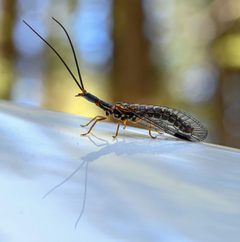
Square-headed Snakeflies, inocelliid snakeflies
Genus Guides
1- Negha(American Square-headed Snakeflies)
is a small of snakeflies (order Raphidioptera) containing eight extant plus fossil . Members are commonly known as square-headed snakeflies due to their distinctive shape. The family is distributed across the Northern Hemisphere, with extant found in temperate forests of Eurasia and North America. Inocelliidae are holometabolous with larvae that inhabit bark and wood of coniferous and deciduous trees, where they prey on other insects. The family includes notable fossil representatives such as Fibla carpenteri from Baltic amber, the largest known snakefly species.
Pronunciation
How to pronounce Inocelliidae: //ˌɪn.oʊˌsɛl.iˈaɪ.di.iː//
These audio files are automatically generated. While they are not always 100% accurate, they are a good starting point.
Identification
capsule broad and roughly square or rectangular in view, contrasting with the more triangular heads of Raphidiidae. (bead-like) rather than . Wings with distinct venation including characteristic crossvein patterns; forewing pterostigma relatively short and broad. Body generally more robust than Raphidiidae. possess the elongated prothorax typical of snakeflies, giving a 'neck-like' appearance. Larvae are elongate, somewhat flattened, with well-developed legs and chewing mouthparts; body covered with fine setae.
Images
Habitat
Terrestrial and arboreal; larvae inhabit bark crevices, under loose bark, and in decaying wood of coniferous and deciduous trees. Associated with mature forest , particularly temperate and forests. One documented , Inocellia (Amurinocellia) calida, was found specifically in trunks of Pinus koraiensis (Korean pine) infested with wood-boring beetles.
Distribution
Northern Hemisphere only; primarily Palearctic with records from Europe, Russia (Far East), China (Jilin, Liaoning provinces), North and South Korea, and northern Iraq (Kurdistan Region). Nearctic records include western North America. Fossil known from Baltic amber (Eocene), Spain, and USA. The Iraqi record of Parainocellia ressli fills a distributional gap between Anatolia and western Iran.
Diet
at all life stages. Larvae feed on various insects including Coleoptera ( larvae and ), Lepidoptera, Hymenoptera, as well as and larvae of Collembola, mites, and spiders. Inocellia (Amurinocellia) calida has been documented as a of Monochamus saltuarius (Cerambycidae) larvae. Adults are also predatory. Larvae may consume prey directly or puncture to extract bodily fluids.
Life Cycle
Holometabolous. Larvae undergo 10-11 instars. Most require a period of low-temperature hibernation (static hibernation) to complete development; without cold stimulation, final instar larvae may moult into aberrant forms with pupal characteristics, undergo additional moults, and eventually perish. One documented specimen developed to without cold stimulation in 21 days of feeding, 10 days , with adult living 17 days.
Behavior
Larvae exhibit feeding and activity. High rates observed: one larva consumed or attacked 23 prey larvae over 21 days. Rapidly locates and attacks prey within galleries and worm-holes in wood. are poor dispersers with relictual distribution patterns, contributing to their limited geographic ranges and .
Ecological Role
Predatory natural enemies of wood-boring beetles and other insects inhabiting bark and decaying wood. Potential agent for pest such as Monochamus saltuarius, a of the pine wood (Bursaphelenchus xylophilus) that causes . Contributes to regulation of in forest .
Human Relevance
Potential biocontrol applications in forestry for management of wood-boring pests and of forest . Scientific interest due to relictual nature and phylogenetic position as one of the most primitive holometabolous insect lineages. Fossil , particularly from Baltic amber, provide important paleontological data on Mesozoic and Cenozoic insect faunas.
Similar Taxa
- RaphidiidaeOther extant snakefly ; distinguished by triangular (not square) capsule, (not ) , and generally more slender body form.
Sources and further reading
- BugGuide
- Wikipedia
- GBIF taxonomy match
- iNaturalist taxon
- NCBI Taxonomy
- Catalogue of Life
- FIRST RECORD OF SNAKEFLY FAMILY INOCELLIIDAE (ORDER, RAPHIDIOPTERA) FROM KURDISTAN REGION, NORTH OF IRAQ
- Inocellia (Amurinocellia) calida (Raphidioptera, Inocelliidae) was first observed as a predator of Monochamussaltuarius (Coleoptera, Cerambycidae) in China, the vector of Bursaphelenchusxylophilus (Aphelenchida, Aphelenchoididae).