
Negha
Navás, 1916
American Square-headed Snakeflies
Species Guides
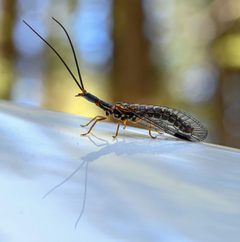
1Negha is a of snakeflies in the Inocelliidae, commonly known as American Square-headed Snakeflies. The genus contains at least three described : N. inflata, N. longicornis, and N. meridionalis. Members of this genus are characterized by their distinctive square-shaped capsules, a trait that distinguishes them within the order Raphidioptera. These insects are predatory as and larvae, feeding on other small arthropods.
Pronunciation
How to pronounce Negha: /ˈnɛɡə/
These audio files are automatically generated. While they are not always 100% accurate, they are a good starting point.
Identification
Negha can be distinguished from other snakefly by their square-shaped capsules, in contrast to the rounded heads found in most other Raphidioptera. The genus is further characterized by features of the wing venation and genitalia, though specific diagnostic characters vary among the three described species. N. meridionalis, described in 1988, is distinguished from by particular morphological features detailed in the original description.
Images
Distribution
of Negha are distributed in North America. N. inflata and N. longicornis have broader distributions, while N. meridionalis appears to have a more restricted range based on its relatively recent description and limited collection records.
Diet
and larval snakeflies are predatory, feeding on small arthropods. Specific prey preferences for Negha have not been documented.
Life Cycle
Negha undergoes complete with , larval, pupal, and stages. Larvae are terrestrial that develop under bark or in soil, with multiple instars before . Pupation occurs in a , with adults emerging to continue predatory feeding.
Behavior
snakeflies are active that use their elongated prothorax to reach forward and capture prey with their forelegs. They are capable of running backwards, a distinctive among insects.
Ecological Role
As of small arthropods, Negha contribute to of potential pest insects in their .
Human Relevance
Negha has no documented direct economic importance to humans. The is of interest to entomologists studying Raphidioptera and evolution.
Similar Taxa
- InocelliaAlso in Inocelliidae, but Inocellia have rounded rather than square and different wing venation patterns.
- AgullaIn Raphidiidae (different family from Negha), with rounded and generally different body proportions.
More Details
Taxonomic History
The Negha was established by Navás in 1916. The three currently recognized were described between 1861 and 1988, with N. meridionalis being the most recently described by U. Aspöck in 1988.