
Athericidae
water snipe flies, ibis flies
Genus Guides
2is a small of flies in the infraorder Tabanomorpha, historically classified within Rhagionidae until separated by Stuckenberg in 1973. The family contains approximately 123 described distributed worldwide across two : Dasyommatinae () and Athericinae. are commonly known as water snipe flies or ibis flies. Larvae are strictly aquatic in fast-flowing montane streams and torrents, while adults are primarily nectar-feeders with some species exhibiting .
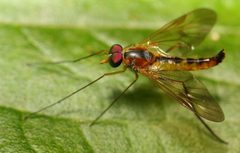
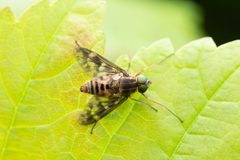
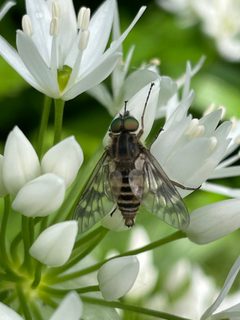
Pronunciation
How to pronounce Athericidae: //æˈθɛrɪsɪˌdiː//
These audio files are automatically generated. While they are not always 100% accurate, they are a good starting point.
Identification
distinguished from related Rhagionidae by aristate and closer phylogenetic affinity to Tabanidae. Larvae uniquely identified by the combination of well-developed capsule and long abdominal with crocheted hooks—structures absent in other aquatic Diptera . Males of some readily identified by . Dasyommatinae ( Dasyomma) separated from Athericinae by distinct morphological features.
Images
Habitat
Larvae are strictly associated with fast-flowing montane streams, torrents, and cold running waters. Preferred larval substrates include moss and gravel. are found in terrestrial in close proximity to sites, typically resting on upper surfaces of leaves near streams; some disperse inland when seeking blood meals.
Distribution
distribution with documented across all major biogeographic regions. Documented occurrences include: Europe (widespread including Corsica, Croatia, Fennoscandia, Germany, North German Lowland), North America (Canada, Quebec), South America (Brazil: Suragina pacaraima, Xeritha plaumanni), Africa (Afrotropical Region with extensive Suragina diversity), and Asia (Yakutia, East Siberia).
Seasonality
with typically occurring from late spring through summer. Ibisia marginata exhibits peak emergence in July with period from June to August. Atherix lantha adults fly from mid-May to late June in Quebec. Emergence timing varies geographically and annually.
Diet
primarily feed on nectar. (blood-feeding) demonstrated in adults of Suragina and Suraginella, suspected in other . Larvae are predatory after the first instar; first-instar larvae do not feed. Larval prey includes aquatic , particularly caddisflies (Trichoptera), mayflies (Ephemeroptera), and amphipods. Some larvae may be saprophagous.
Life Cycle
cycle with five larval instars. deposited in large clusters, often under bridges or overhanging structures; females of some die attached to egg masses. First-instar larvae appear in early summer, with rapid growth through subsequent instars. occurs primarily in the fifth (final) larval instar. occurs in terrestrial , typically in moss or moist bank substrates. emerge and fly in spring to summer. Larval development in some species may extend to two years.
Behavior
Larvae are active using piercing-sucking feeding mechanism. commonly exhibit leaf-palpation —stroking or palpating upper leaf surfaces, a trait shared with Tabanidae. Adults rest on upper leaf surfaces near streams. reproductive strategy: all deposited in single event, followed by female death. Some form conspicuous clusters of mummified females attached to egg masses under bridges.
Ecological Role
Larvae function as in macrozoobenthic of lotic , contributing to . Prey selectivity varies with predator size and prey vulnerability. serve as through nectar feeding and may function as blood-feeding where occurs.
Human Relevance
Limited direct economic impact. Larvae serve as bioindicators for cold, fast-flowing, well-oxygenated aquatic . Some (e.g., Atherix ibis) form conspicuous under bridges, occasionally noted in structural inspections. No significant medical or veterinary importance established, though species have potential as biting nuisances.
Similar Taxa
- RhagionidaeHistorically included ; distinguished by phylogenetic position, aristate in Athericidae, and larval .
- TabanidaeSister group to ; shares leaf-palpation and some , but distinguished by and larval (Tabanidae larvae in moist soil/organic matter, not torrential streams).
More Details
Taxonomic History
Removed from Rhagionidae by Stuckenberg in 1973; elevated to status based on morphological and phylogenetic evidence. Now firmly placed within Tabanomorpha as sister to Tabanidae.
Subfamily Classification
Two recognized: Dasyommatinae (, Dasyomma) and Athericinae (all remaining extant genera: Atherix, Atrichops, Microphora, Pachybates, Suragina, Suraginella, Trichacantha, Xeritha, Asuragina).
Fossil Record
Extinct †Athericites (Eocene, UK) and †Succinatherix (Eocene Baltic amber) documented.
Sources and further reading
- BugGuide
- Wikipedia
- GBIF taxonomy match
- iNaturalist taxon
- NCBI Taxonomy
- Catalogue of Life
- Biology, ecology and biogeography of Athericidae family (Hymenoptera: Athericidae)
- Revision of Afrotropical Suragina Walker, 1859 (Diptera, Athericidae)
- The Rhagionidae, Athericidae and Vermileonidae of Corsica (Diptera, Brachycera)
- Afrotropical Atrichops Verrall (Diptera, Athericidae) with description of a new species
- Ibisia marginata (Fabricius, 1781) (Diptera, Athericidae): Distribution and Perennial Emergence Patterns in Croatia
- Geographical distribution of Tabanomorpha (Diptera, Brachycera): Athericidae, Rhagionidae, Vermileonidae, and small families
- Distribution of <i>Atherix ibis</i> (Diptera, Athericidae) in Fennoscandia
- Records ol <i>Atherix ibis</i> in Finland (Diptera, Athericidae)
- Diptera of Yakutia. Lower Brachycera: Athericidae, Xylophagidae and Rhagionidae (Diptera) with description of a new species of the genus Chrysopilus Macquart
- The life cycle of the aquatic snipe fly Atherix lantha Webb (Diptera Brachycera; Athericidae) in Quebec
- The Life Cycle of Atrichops crassipes Meigen, 1820 (Diptera: Athericidae) at the Lower Schierenseebrook, a Lake Outflow in the North German Lowland
- Feeding behaviour of predatory larvae of Atherix lantha Webb (Diptera: Athericidae)
- Distribution and ecological preferences of the species of the family Athericidae in three hydrobiological ecoregions of Central Europe
- West Palearctic Athericidae: the Genus Ibisia Rondani, 1856. I. Rediscovery of I. Maroccana (Séguy, 1930) at the Locus Typicus, and its Ecology (Diptera: Brachycera: Orthorrhapha)