
Ampulicidae
Shuckard, 1840
cockroach wasps, jewel wasps
Genus Guides
2- Ampulex(cockroach wasps)
- Dolichurus(cockroach wasps)
, commonly called cockroach wasps, is a small of about 170 of solitary hunting . All known species are specialized of , which they paralyze with precise stings to the and use as living food for their larvae. The family is considered the most primitive group of sphecoid wasps. Many species exhibit -mimicry in appearance, while others display brilliant metallic coloration.
Pronunciation
How to pronounce Ampulicidae: /æmˈpjuːlɪsɪˌdiː/
These audio files are automatically generated. While they are not always 100% accurate, they are a good starting point.
Identification
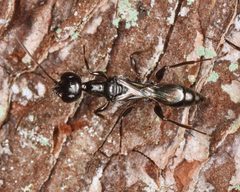
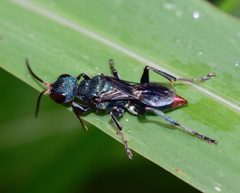
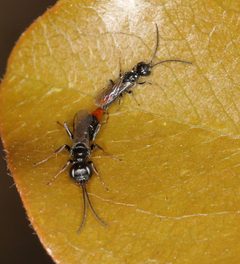
Elongated and a pronounced neck-like constriction behind the are distinctive features. The prothorax is long and typically tuberculate with a high collar. are inserted low on the with sockets close to or touching the fronto-clypeal structure. is strongly (stalked). Deep grooves are present on the . Many are -mimetic in form, though some exhibit metallic blue, green, or pink coloration. Forewings have two to three submarginal , two recurrent , and a marginal cell that is apically acuminate and appendiculate. Mid-tibiae bear two spurs, and claws have an inner tooth.
Images
Habitat
Primarily tropical and subtropical regions, with some extending into temperate zones. Species are associated with forested , particularly areas with dead standing trees and decaying wood where wood cockroaches occur. The Ampulex has been observed running on tree trunks in deciduous forests. Vertical stratification studies indicate some species occupy forest understory layers.
Distribution
Worldwide distribution with greatest diversity in tropical regions. The largest , Ampulex (132 ), has global distribution. Trirogma (7 species) occurs in Asia. Dolichurus (50 species) is worldwide. Paradolichurus (4 species) is restricted to the New World. Aphelotoma (8 species) and Riekefella (1 species) are Australian endemics. In North America, two Ampulex species occur: A. canaliculata in the eastern U.S. west to Wisconsin, Missouri, and Kansas, and A. ferruginea in Florida and Texas. Records exist from Iran, Turkey, Arabian Peninsula, China, Australia, and Estonia.
Diet
are not predatory; larvae feed exclusively on living . Prey includes wood cockroaches of the Parcoblatta in North American forests, and the American cockroach (Periplaneta americana) for some tropical .
Life Cycle
Females sting in two precise locations: first in thoracic nerve ganglia to temporarily paralyze the prey, then in the brain to disable the escape reflex. The subdued but living cockroach is led by its to a pre-existing cavity, where an is laid on it. The larva hatches and consumes the living , eventually constructing a cocoon within the host . In Ampulex compressa, the cocoon consists of three capsules: external and middle capsules of structurally distinct silken threads, and an internal capsule of brittle substance without distinguishable threads.
Behavior
Females exhibit highly stereotyped prey handling: after stinging, they often clip the 's with and drink haemolymph before backwards and dragging the prey by its clipped antennae to steer it to a nest site. The cockroach, though capable of walking, does not attempt to flee due to neural manipulation. Some , including Ampulex compressa, have been observed to cache prey in cavities and block entrances with debris.
Ecological Role
Specialized that regulate in forest . Their unique neurobiological manipulation of prey represents a distinctive -prey interaction.
Human Relevance
Ampulex compressa, the emerald cockroach wasp or jewel wasp, has become widely known through scientific documentation and video recordings of its prey manipulation . The has been kept in laboratory and zoo settings. No economic importance as biocontrol agents has been established.
Similar Taxa
- SphecidaeHistorically included ; distinguished by different wing venation, cocoon structure, and less specialized .
- CrabronidaeRelated sphecoid with more diverse prey associations; distinguished by different wing venation and cocoon .
- FormicidaeMany are -mimetic in appearance; distinguished by wing presence in most , petiole structure, and .
Sources and further reading
- BugGuide
- Wikipedia
- GBIF taxonomy match
- iNaturalist taxon
- NCBI Taxonomy
- Catalogue of Life
- Bug Eric: Wasp Wednesday: Ampulex canaliculata
- New data on Spheciformes fauna (Hymenoptera: Ampulicidae, Sphecidae, Crabronidae) of Turkey
- Catalogue of Ampulicidae, Crabronidae and Sphecidae of Iran (Hymenoptera, Apoidea)
- Cocoon morphology of the cockroach-hunting apoid wasp Ampulex compressa (Fabricius) (Hymenoptera, Ampulicidae).
- A REVIEW OF FAUNA AND ECOLOGY OF DIGGER WASPS (HYMENOPTERA: AMPULICIDAE, CRABRONIDAE, SPHECIDAE) OF THE NATURE RESERVE «KARADAGSKIY»
- Family Ampulicidae (Insecta: Hymenoptera) as a parasitoid of cockroaches (Insecta: Blatidae)
- Biodiversity of the aculeate wasps (Hymenoptera: Aculeata) of the Arabian Peninsula: Apoidea (Spheciformes), Ampulicidae
- A revision of the wasp genus Dohchurus Latreille, 1809 in Australia (Hymenoptera: Apoidea: Ampulicidae)
- Multifaceted Defense against Antagonistic Microbes in Developing Offspring of the Parasitoid Wasp Ampulex compressa (Hymenoptera, Ampulicidae)
- Vertical stratification of selected Hymenoptera in a remnant forest of the Po Plain (Italy, Lombardy) (Hymenoptera: Ampulicidae, Crabronidae, Sphecidae)
- Nouvelles observations sur le comportement de quelques espèces de Sphéciformes paléarctiques (Hymenoptera, Ampulicidae, Sphecidae, Crabronidae)
- THE DISTRIBUTION AND PHENOLOGY OF THE SPHECOIDEA (HYMENOPTERA, ACULEATA) SPECIES IN ESTONIA I. THE FAMILIES AMPULICIDAE, SPHECIDAE PEMPHREDONIDAE, ASTATIDAE, AND LARRIDAE
- Digger wasps of the families Ampulicidae and Sphecidae (Hymenoptera: Apoidea) in the collection of the Institute of Systematics and Ecology of Animals, Novosibirsk, Russia
- Egg-laying behavior and morphological and chemical characterization of egg surface and egg attachment glue of the digger wasp Ampulex compressa (Hymenoptera, Ampulicidae)
- Notes on the Biology and Behaviour of the Jewel Wasp,Ampulex compressa(Fabricius, 1781) (Hymenoptera; Ampulicidae), in the Laboratory, Including First Record of Gregarious Reproduction
- Two new species of Dolichurus Latreille (Hymenoptera, Ampulicidae) from China, with a key to species of the genus.
- Chromosome-level genome assembly of Ampulex clypecomplana Chen & Li (Hymenoptera: Ampulicidae).