
Deltopauropus
MacSwain & Lanham, 1948
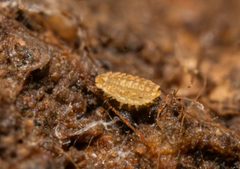
Deltopauropus is a of minute myriapods in the Brachypauropodidae, established by MacSwain and Lanham in 1948. Pauropods in this genus are among the smallest terrestrial arthropods, inhabiting soil and leaf litter. As members of the order Tetramerocerata, they possess four antennal segments. The genus is rarely encountered due to its cryptic lifestyle and minute size.
Pronunciation
How to pronounce Deltopauropus: //ˌdɛl.toʊˈpaʊ.roʊ.pəs//
These audio files are automatically generated. While they are not always 100% accurate, they are a good starting point.
Identification
Distinguished from other pauropod primarily by genitalic and antennal characteristics, though specific diagnostic features require microscopic examination. The Brachypauropodidae is characterized by short, stout legs relative to body length. -level identification within Deltopauropus requires examination of male genitalia and pygidial structures.
Images
Habitat
Soil-dwelling; found in mineral soil and leaf litter of forest . Inhabits the deep soil profile, generally below the organic horizon.
Distribution
Documented from western North America, with records from California and surrounding regions. Distribution data remains sparse due to limited sampling effort for soil microarthropods.
Ecological Role
Contributes to soil processes as a component of the soil . Functions as a decomposer, processing organic matter in mineral soil horizons.
Human Relevance
No direct economic or medical significance. Occasionally encountered in soil research and biodiversity surveys.
Similar Taxa
- BrachypauropusCongeneric member; distinguished by antennal and genitalic , though both require expert examination for reliable separation
- AllopauropusMember of Pauropodidae; differs in having longer, more slender legs and distinct pygidial sternum
More Details
Taxonomic history
The was erected by MacSwain and Lanham in 1948 based on material from California. It remains one of the less studied pauropod genera, with few subsequent taxonomic revisions.
Collection challenges
Specimens are rarely collected alive due to their minute size (typically under 2 mm) and deep soil . Most records derive from soil extraction methods such as or flotation techniques.