
Selenocheir sinuata
Shelley, 1994
Selenocheir sinuata is a flat-backed millipede to Northern California, first described by Rowland M. Shelley in 1994 from specimens collected in 1966. The species belongs to the Xystodesmidae and exhibits distinctive banded coloration. Its restricted range spans foothill bordering the northern Sacramento Valley.
Pronunciation
How to pronounce Selenocheir sinuata: //sɛˌlɛnəˈkɪər ˌsɪnjuˈeɪtə//
These audio files are automatically generated. While they are not always 100% accurate, they are a good starting point.
Identification
Distinguished from similar xystodesmid millipedes by its specific banded color pattern with black metaterga and reddish-orange tergites, sometimes with incomplete coloration where lateral portions of tergites remain black. to Northern California foothills, which helps constrain identification geographically. Diagnostic features require examination of male for definitive identification.
Images
Appearance
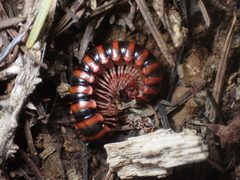
Body displays a banded color pattern with black metaterga and reddish to orange or yellow tergites. Coloration on tergites is sometimes incomplete, with paranota and central portions colored while mid portions to either side remain black. As a member of Polydesmida, the body is flattened dorsoventrally.
Habitat
Foothill bordering the northern portions of the Sacramento Valley in Northern California. Specific microhabitat details such as elevation range, substrate preferences, or vegetation associations have not been documented.
Distribution
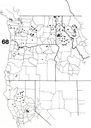
to Northern California. Known from foothills in Humboldt County east to Shasta County and south to El Dorado County, spanning the northern Sacramento Valley border region.
Similar Taxa
- Other Selenocheir speciesCongeneric in the same share the California distribution and require examination of for differentiation
- Other Xystodesmidae in Northern CaliforniaMany xystodesmid millipedes in the region exhibit banded coloration; S. sinuata is distinguished by its specific color pattern and geographic restriction to the northern Sacramento Valley foothills
More Details
Type specimen history
The was described in 1994 based on specimens collected by J. S. Buckett and M. R. Gardner in 1966, representing a 28-year gap between collection and formal description.