
Californiulus yosemitensis
Chamberlin, 1941
Yosemite Millipede
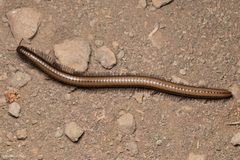
Californiulus yosemitensis is a large cylindrical in the Paeromopodidae, reaching up to 11 cm in length. It is distinguished by a broad yellow or orange band with a central black stripe running the length of the black body. The is the most widespread member of its , occurring across the Sierra Nevada and adjacent ranges from southwestern Oregon to Kern County, California. It was described by Ralph Vary Chamberlin in 1941 from specimens collected in Yosemite National Park.
Pronunciation
How to pronounce Californiulus yosemitensis: //kælɪˌfɔːrniˈjuːləs ˌjoʊsəmaɪˈtɛnsɪs//
These audio files are automatically generated. While they are not always 100% accurate, they are a good starting point.
Identification
Distinguished from other western North American millipedes by the combination of large size (up to 11 cm), the broad yellow/orange band with central black stripe, and black base coloration. Co-occurs with Paeromopus paniculus in parts of Yosemite National Park, which is larger and lacks the distinctive banded pattern. Other Californiulus have more restricted distributions and may differ in coloration or body proportions.
Images
Habitat
Found primarily under logs in relatively dry ; occasionally occurs in moist habitats. Occupies forested and woodland environments across mountain ranges in western North America.
Distribution
Occurs from extreme southwestern Oregon south to Kern County, California. documented in the Warner Mountains, Cascade Range, and Sierra Nevada. It is the most widespread in the Californiulus.
Similar Taxa
- Paeromopus paniculusCo-occurs in Yosemite National Park; larger in size and lacks the distinctive yellow/orange band with central black stripe
- Other Californiulus speciesMore restricted geographic ranges; may differ in color pattern and body proportions
More Details
Taxonomic History
Originally described by Ralph Vary Chamberlin in 1941 from a collected in Yosemite in 1931, now housed at the National Museum of Natural History. Chamberlin later described Klansolus mononus and K. obscurans, which were subsequently synonymized with C. yosemitensis.