
Underwoodia iuloides
(Harger, 1872)
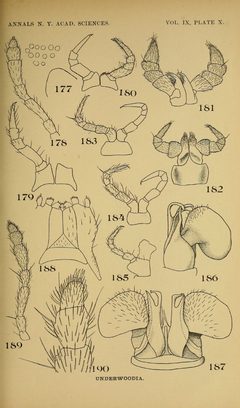
Underwoodia iuloides is a in the Caseyidae. It is one of three species in the Underwoodia, which exhibits a Holarctic distribution pattern. The species is characterized by specific configurations of the colpocoxites, particularly branches a and c. show a strongly female-biased sex ratio, suggesting .
Pronunciation
How to pronounce Underwoodia iuloides: /ˌʌndərˈwʊdiə ˌaɪjuloɪˈdiːz/
These audio files are automatically generated. While they are not always 100% accurate, they are a good starting point.
Identification
Distinguished from by the configuration of branches a and c of the colpocoxites and the degree of segregation of these branches from process b. Males can be identified by gonopod ; females may be indistinguishable from other Underwoodia without molecular or geographic data.
Images
Distribution
Ranges across Canada from Newfoundland to Saskatchewan, extending southward in the United States to New York, Michigan, Wisconsin, North Dakota, and northeastern New Mexico.
Similar Taxa
- Underwoodia tidaOverlaps in western North America; distinguished by colpocoxite branch configuration and more westerly distribution from Rocky Mountains to northern Utah and possibly coastal British Columbia
- Underwoodia kurtschevaeOccurs in east Asia (Sakhalin Island, Kurile Islands, Russian Far East); distribution separates it from U. iuloides
More Details
Parthenogenesis
Females greatly outnumber males in this , suggesting is the primary mode of . This trait appears to be an autapomorphy for the Underwoodia.
Taxonomic History
Underwoodia hespera Chamberlin has been synonymized under U. tida, not U. iuloides.