
Theatops posticus
Say, 1821
Big-leg Centipede
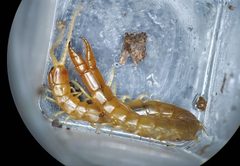
Theatops posticus is a common eastern Nearctic in the Cryptopidae. It exhibits a continental distribution pattern with eastern and western segregated by approximately 1,200 km in Texas and New Mexico. The has been recorded from Santa Cruz Island in the Pacific Ocean off the southern California coast. Southwestern populations show morphological variation intermediate between eastern T. posticus and the T. californiensis.
Pronunciation
How to pronounce Theatops posticus: /ˈθiːəˌtɒps ˈpɒstɪkəs/
These audio files are automatically generated. While they are not always 100% accurate, they are a good starting point.
Identification
Southwestern individuals may exhibit small spurs on the ultimate prefemora and/or , and coxopleurae with slightly elevated, caudally produced medial borders. These features are intermediate between those of eastern T. posticus and T. californiensis. The can be distinguished from T. californiensis by these intermediate morphological conditions in geographically intermediate .
Images
Distribution
Widespread in Arizona; recorded from southern Nevada, southwestern New Mexico, southern California, and northwestern Mexico (Baja California Norte, Sonora, and Chihuahua). Eastern occur in the eastern Nearctic. The is known from Santa Cruz Island off the southern California coast. Eastern and western populations are separated by approximately 1,200 km in Texas and New Mexico.
Similar Taxa
- Theatops californiensisPreviously confused with T. posticus due to phenotypic resemblance; southwestern of T. posticus show intermediate proving convergence rather than conspecificity. T. californiensis occurs in California and southern Oregon.
- Theatops erythrocephalusEuropean resembling T. californiensis; the phenotypic similarity represents convergence, not close relationship.
More Details
Taxonomic history
The name Theatops erythrocephalus was previously considered for the Pacific due to phenotypic resemblance to the European T. erythrocephalus, but this represents convergence. The name T. californiensis Chamberlin is available and correct for the Pacific species.
Sources and further reading
- BugGuide
- GBIF taxonomy match
- iNaturalist taxon
- NCBI Taxonomy
- Catalogue of Life
- Bug Eric: Blacklighting Already?
- "Go Pick Up a Mite!" Two Cents From an Acarologist and His Love for Mites
- Ray Fisher, Ph.D. - Entomology Today
- The centipede Theatops posticus (Say) (Scolopendromorpha: Cryptopidae) in the southwestern United States and Mexico