
Dolophilodes
Ulmer, 1909
Species Guides
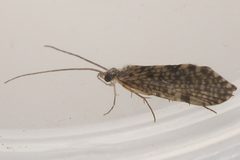
2Dolophilodes is a of in the Philopotamidae. in this genus are net-spinning caddisflies whose larvae construct silk nets in streams to capture fine organic particles. The genus is native to eastern North America, where larvae inhabit clear montane streams and build characteristic clustered retreats under rocks.
Pronunciation
How to pronounce Dolophilodes: /ˌdoʊ.loʊˈfɪl.oʊˌdiːz/
These audio files are automatically generated. While they are not always 100% accurate, they are a good starting point.
Images
Habitat
Larvae inhabit freshwater streams, particularly clear montane streams with gravel or cobble substrates. They construct feeding nets in shallow streams with small pools joined by riffles, under rocks where water currents flow through. Documented from hard water streams with limestone gravel and brown water streams with granite gravel.
Distribution
Eastern North America. Documented from Minnesota and Newfoundland south to Georgia, with specific records from Vermont and Ontario.
Seasonality
occurs primarily in summer (late June to late August), with some emergence possibly in mid-winter. females emerging in summer are fully winged; those emerging in March are often brachypterous.
Diet
Larvae are collector-filterers that feed on fine particulate organic matter (FPOM) and diatoms captured in their silk nets.
Life Cycle
At least (two per year) with emergences in late June and August. Larvae present year-round with peak densities in August.
Behavior
Larvae construct elongated silk net retreats—up to 60 mm long in final instar—consisting of over a kilometer of silk with approximately 100 million mesh openings. Nets are built in characteristic clusters containing mixed instars at preferred sites, with the upstream end anchored to the substrate and the downstream end free to permit respiratory current flow. sometimes breed on snow.
Ecological Role
Collector-filterer that processes fine particulate organic matter in stream . Larval nets provide for other aquatic .