
Limothrips
Haliday, 1836
Grain thrips, Barley thrips
Species Guides
1- Limothrips denticornis(barley thrips)
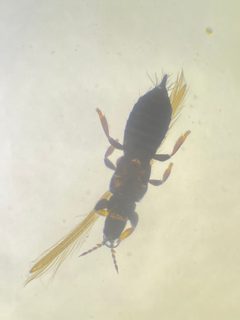
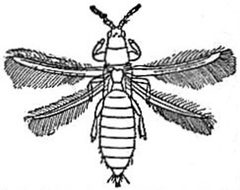
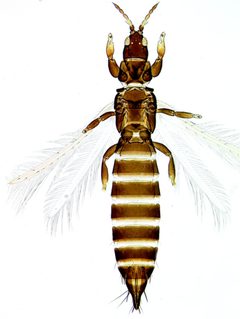
Limothrips is a of in the Thripidae comprising six recognized . The genus includes significant agricultural pests, particularly Limothrips cerealium (grain thrips) and Limothrips denticornis (barley thrips), which feed on cereals and grasses. Species exhibit wing dimorphism, with both winged () and wingless () forms documented. Several species have been documented as crop pests causing reduced seed set in wheat, oats, and barley.
Pronunciation
How to pronounce Limothrips: //ˈlɪmoʊˌθrɪps//
These audio files are automatically generated. While they are not always 100% accurate, they are a good starting point.
Identification
The is characterized by wing dimorphism, with occurring in both fully winged and wingless forms. An illustrated sex-based key to species has been developed. Diagnostic characters include antennal segmentation and body setation patterns. Limothrips angulicornis was recently documented in form for the first time. Species within the genus require microscopic examination for reliable identification.
Images
Habitat
Primarily associated with graminaceous plants including wheat, oats, barley, rye, and various meadow grasses. females utilize sheltered locations such as grass tussocks, bark crevices (particularly pine bark), and vertebrate nests. Museum and storage environments can support when grain-based materials are present.
Distribution
Holarctic distribution with records from Europe, Asia, Africa, Australasia, North America, Central America, and South America. Specific documented locations include Europe (extensive records), Australia, New Zealand, Hawaii, Canada, USA, Chile, and Guatemala. Within Europe, documented from Scandinavia south to the Mediterranean including the Azores, Canary Islands, and Cyprus.
Seasonality
Activity period primarily spring through summer. For Limothrips cerealium, females emerge from hibernation in late May (timing varies with temperature). Take-off threshold temperature is approximately 18.4°C, with a temperature-dependent development period of 4–42 days before readiness. Most are laid during inflorescence of cereals (growth stages 10–10.5 on Feekes ). First females leave cereals in August to feed on grasses before hibernation. The appears to be single-brooded in temperate regions.
Diet
Phytophagous, feeding on developing grains and floral structures of cereals and grasses. Limothrips cerealium feeds on wheat, oats, barley, and various meadow grasses. Wheat ears with water content below approximately 45% are not favored. Feeding on grain paste materials has been documented in museum environments.
Host Associations
- Triticum aestivum - wheat
- Avena sativa - oats
- Hordeum vulgare - barley
- Secale cereale - rye
- Various Poaceae - meadow grasses
- Lolium multiflorum - Italian ryegrass
- Pinus - hibernation site on bark, particularly southern-facing bark
- Vertebrate nests - L. denticornis recorded in nests of 20 bird and mammal , primarily via passive transport on nest material
Life Cycle
Complete from to requires 29–35 days under favorable conditions. Egg stage: 10–13 days. Larval stage: 13–17 days. Pre-pupal stage: 2–3 days. Pupal stage: 6–7 days. Eggs are laid within leaf of plants, with highest in flag leaf sheath during inflorescence . stage is fertilized adult female; males have short lifespans and do not persist through winter.
Behavior
Strong thigmotactic (preference for contact with surfaces and tight spaces), leading to in crevices. Pre- behavior includes wing combing and flexing. Take-off is temperature-dependent with threshold of approximately 18.4°C. Spring from hibernation sites is triggered by warming; on sun-exposed southern bark surfaces become flight-ready earlier than those on cooler northern exposures. Infiltration of vertebrate nests occurs primarily through passive transport on grass nest material (88% of cases), with peak invasion in spring and autumn. Wind direction influences initial crop patterns, with greatest on windward field edges.
Ecological Role
Herbivore in cereal and grassland . Documented as prey for predatory Trombidium larvae. Serves as for fungus Neozygites parvispora in Oregon. in museum environments may be supported by microhabitats created by other pest insects. Potential interactions: Pteromalid have been found associated with where Limothrips occur, though relationships remain speculative.
Human Relevance
Significant agricultural pest causing reduced seed set in wheat, oats, and barley. Injury severity increases proportionally with . Documented as a museum pest in association with grain-based glue pastes used in art conservation; has been found infesting oil paintings in Taiwan. Rarely associated with human infestation, with one documented case linked to onychomycosis. Laboratory colonies can cause equipment damage due to thigmotactic .
Similar Taxa
- AptinothripsSimilar cereal-feeding with comparable and -laying ; both contain that are pests of Gramineae
More Details
Wing dimorphism
The exhibits remarkable wing dimorphism, with both fully winged () and completely wingless () forms documented. This evolutionary transition from to condition has been studied specifically in the context of cereal adaptations. Recent taxonomic work confirmed the first documented record of apterous Limothrips angulicornis.
Nest association ecology
Limothrips denticornis represents a model system for studying transport mechanisms into vertebrate nests. Statistical analysis of over 1,500 nests demonstrated that thrips presence correlates strongly with grass as nest material, not with nest size, location, or height. Passive transport on nest material accounts for 88% of nest infiltration events.
Sources and further reading
- BugGuide
- Wikipedia
- GBIF taxonomy match
- iNaturalist taxon
- NCBI Taxonomy
- Catalogue of Life
- A Taste for Paste: Beetle Larvae Fond of Museum Paintings' Glue Lining
- Limothrips cerealium . [Distribution map].
- Human Limothrips cerealium infestation associated with onychomycosis
- Thigmotactic Behavior of Limothrips cerealium (Thysanoptera: Thripidae) Leads to Laboratory Equipment Damage in the Czech Republic
- Taxonomic review of Limothrips Haliday (Thysanoptera: Thripidae): Distribution, wing dimorphism, and an illustrated key to species
- THE SPATIAL DISTRIBUTION OF LIMOTHRIPS DENTICORNIS HALIDAY (THYSANOPTERA: THRIPIDAE) EGGS ON SPRING BARLEY
- Neozygites parvispora , a pathogen of Limothrips sp. associated with Lolium multiflorum in Oregon
- The effect of weather on emergence and take‐off of overwintering Limothrips cerealium Haliday (Thysanoptera)
- Cereal pests among nest parasites – the story of barley thrips, <i>Limothrips denticornis</i> Haliday (Thysanoptera: Thripidae)
- THE ANNUAL CYCLE OF LIMOTHRIPS CEREALIUM HALIDAY (THYSANOPTERA) AND ITS DISTRIBUTION IN A WHEAT FIELD
- BIOLOGY AND LIFE HISTORY OF LIMOTHRIPS CEBEAL1UM HALIDAY AND APTINOTHRIPS RUFUS GMELIN FEEDING ON GRAMINEAE