
Cuneopalpus
Badonnel, 1943
damp barklice
Species Guides
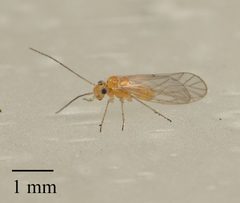
1Cuneopalpus is a of damp barklice in the Elipsocidae, erected by French entomologist André Badonnel in 1943. The genus contains a single described , Cuneopalpus cyanops, which was originally described as Eclipsocus cyanops in 1876 before being reclassified. Members of this genus are found across a broad geographic range spanning Europe, northern Asia, and North America.
Pronunciation
How to pronounce Cuneopalpus: /ˌkjuːniˈɒlpəs/
These audio files are automatically generated. While they are not always 100% accurate, they are a good starting point.
Identification
The single described Cuneopalpus cyanops can be recognized by its orange coloration. Distinguishing features from other Elipsocidae are not documented in available sources.
Images
Habitat
Associated with damp environments, consistent with the "damp barklice." Specific microhabitat details are not documented.
Distribution
Recorded from Benelux, Croatia, Greece, Ireland, Italy, Scandinavia (Denmark, Norway, Sweden), the United Kingdom, Central Europe, northern Asia, and North America.
Diet
Cuneopalpus cyanops has been observed feeding on hemlock, oak, and sea buckthorn.
Host Associations
- hemlock - food source
- oak - food source
- sea buckthorn - food source
Similar Taxa
- EclipsocusCuneopalpus cyanops was originally described under this ; the two genera can be distinguished by the characters used by Badonnel (1943) to erect Cuneopalpus, though specific diagnostic features are not detailed in available sources.
More Details
Taxonomic history
The was erected by André Badonnel in 1943 in Faune de France: 42, Pscocoptères, with Cuneopalpus cyanops designated from the previously described Eclipsocus cyanops (Aaron, 1876).